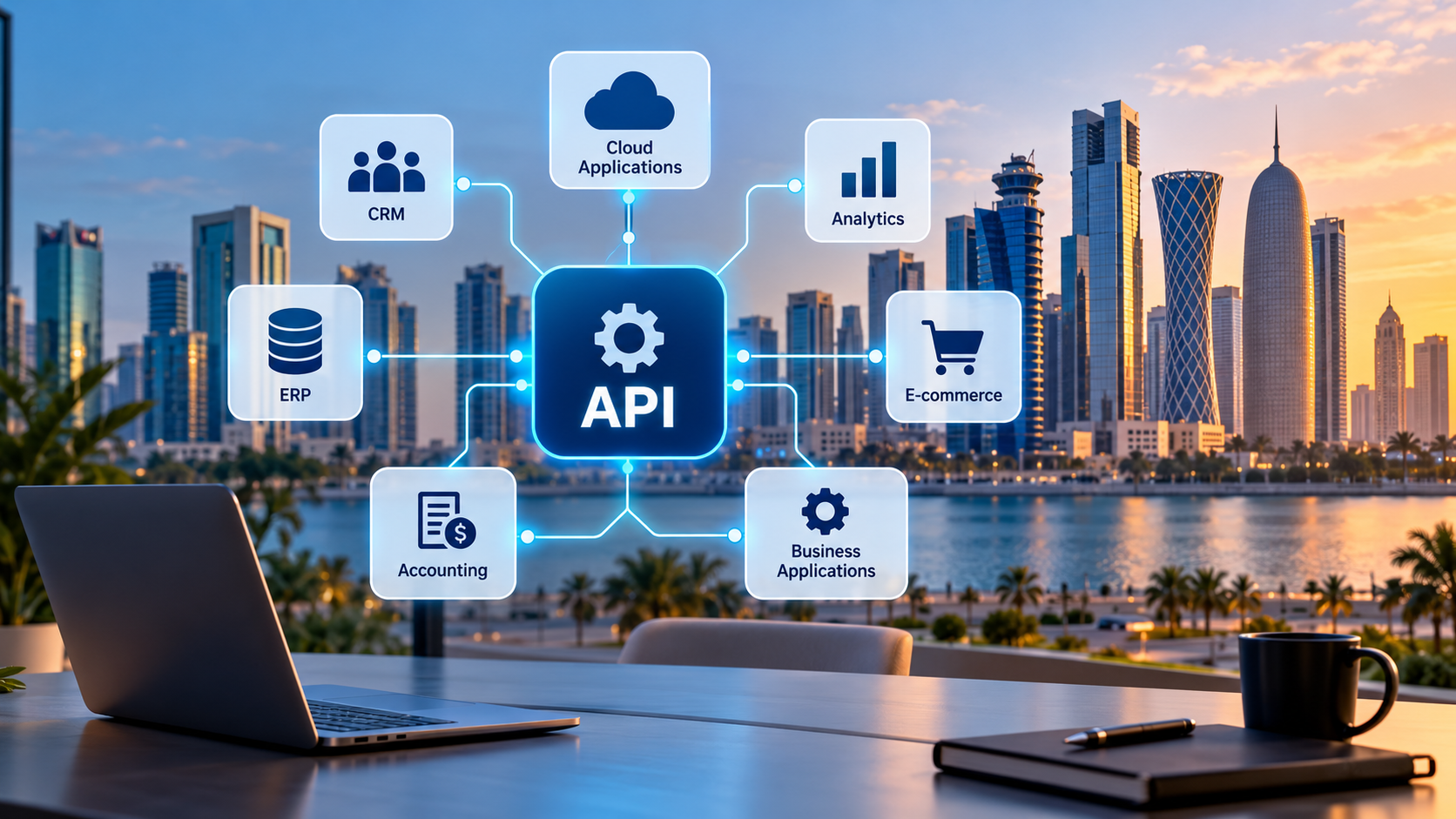

Modern businesses depend on multiple software applications to manage customers, finances, inventory, sales, and daily operations. However, disconnected systems often create duplicate records, manual data entry, reporting delays, and operational inefficiencies.
API integration solves this challenge by allowing different software applications to exchange information and trigger actions automatically. Businesses in Doha, Qatar, can use API connectivity to connect their existing tools, streamline workflows, and create a more connected digital environment.
This guide explains how API integration works, its business benefits, common use cases, security considerations, and the steps companies can take to implement an effective integration strategy.
What Is API Integration?
API integration connects two or more software applications through application programming interfaces (APIs). An API defines how applications request information, exchange data, and access specific functions.
For example, an e-commerce website can connect to an inventory management system through an API. When a customer places an order, the integration can update stock levels and send order information to the relevant business system.
Similarly, a company can connect its customer relationship management (CRM) software with an enterprise resource planning (ERP) platform to share customer records, sales information, and order details.
Common API integration technologies and concepts include:
- REST API: Uses standard HTTP methods to exchange resources, commonly in JSON format.
- SOAP API: Uses structured messages and defined protocols for communication between applications.
- Webhooks: Send event notifications to another system when a specific action occurs.
- API gateway: Provides a central point to manage API access, security policies, and traffic.
- Middleware: Connects applications, transforms data, and coordinates workflows between systems.
The right approach depends on the applications involved, the required data flow, performance expectations, and security requirements.
How Does API Integration Work?
API integration follows a defined process that enables applications to communicate reliably.
- An application sends a request. A website, mobile application, or business platform requests information or initiates an action.
- The API validates the request. The receiving system checks authentication, permissions, and the request format.
- The receiving application processes the request. It retrieves information, updates a record, or performs the requested operation.
- The API returns a response. The requesting application receives the result, an acknowledgement, or an error message.
- The integration handles the outcome. Depending on the workflow, the connected system can update its records, notify a user, or retry a failed operation.
Consider a Doha-based retailer that receives orders through an online store. An API can transfer each order to the inventory and accounting systems. The business can then reduce manual entry and improve the consistency of its operational records.
For more complex workflows, integration platforms can coordinate multiple APIs, process events asynchronously, and manage failures without interrupting the entire business process.
Why Is API Integration Important for Businesses in Qatar?
API integration can improve operational efficiency when businesses use multiple applications that need consistent, timely information.
1. Automate Repetitive Business Processes
Manual data transfer consumes employee time and increases the risk of human error. API connectivity can automate tasks such as order processing, customer record updates, invoice creation, and lead assignment.
For example, a new enquiry submitted through a website can enter a CRM automatically. The system can assign the lead to a sales representative and trigger a follow-up workflow.
2. Improve Data Accuracy and Consistency
Disconnected applications often store conflicting versions of the same information. API integration helps systems exchange approved updates and reduces unnecessary duplicate entry.
Businesses should establish clear data ownership and validation rules to prevent conflicting updates across connected applications.
3. Connect Existing Business Software
Companies do not always need to replace their current technology to improve operations. API integration can connect suitable legacy applications, cloud platforms, and newly developed software.
Explore our system integration services to understand how connected applications can support more coordinated business operations.
4. Improve Customer Experience
Connected systems help employees access more complete customer information. A sales representative can review order history, support teams can check account details, and customers can receive timely updates.
Consequently, businesses can reduce information gaps and deliver more consistent service across digital channels.
5. Support Business Growth
As transaction volumes increase, manual workflows become harder to manage. Well-designed API integrations can support additional applications, locations, services, and business processes.
Scalability still depends on the underlying architecture, API limits, infrastructure capacity, and monitoring strategy.
Common API Integration Use Cases
API integration supports a wide range of business functions across industries in Doha and Qatar.
| Business function | Integration example | Potential benefit |
| Sales and CRM | Connect website enquiries with CRM software | Faster lead handling |
| Finance and accounting | Transfer approved order and invoice data | Less manual reconciliation |
| E-commerce | Connect online stores with inventory systems | More consistent stock records |
| ERP | Exchange purchasing, sales, and inventory data | Better operational visibility |
| Customer support | Connect helpdesk software with customer records | More informed support |
| Marketing | Transfer consented lead and campaign data | Better campaign coordination |
| Logistics | Exchange order and delivery status updates | Improved shipment visibility |
For businesses that manage online sales, website inventory integration can connect store operations with inventory systems.
Companies that need coordinated customer and financial records can also explore CRM and ERP integration.
The best use cases start with a specific operational problem, a measurable objective, and a clear understanding of which systems own each data record.
REST API Integration: What Businesses Should Know
REST API integration is a common approach to connecting web applications and business software. REST APIs typically use HTTP methods and structured representations, often JSON, to exchange information.
Common HTTP methods include:
- GET: Retrieve information.
- POST: Submit information or initiate an operation.
- PUT: Replace a resource representation.
- PATCH: Update selected parts of a resource.
- DELETE: Request removal of a resource.
Each method has defined behaviour, and the receiving API determines which operations are permitted.
For example, a reporting application might use a GET request to retrieve sales figures, while an order management system might use a POST request to submit a new order.
Businesses should review API documentation, authentication requirements, request limits, versioning policies, error responses, and data formats before selecting an integration approach. REST is not automatically the best choice for every scenario. Existing SOAP services, webhooks, messaging systems, or integration platforms may suit specific requirements better.
API Integration Security and Reliability
An integration can create operational and security risks if it exposes sensitive information or fails without detection. Businesses should include security and monitoring in the design rather than treating them as final implementation tasks.
Important safeguards include:
- Strong authentication: Use suitable mechanisms such as OAuth 2.0 or securely managed credentials.
- Access controls: Apply least-privilege permissions so each application can access only the resources it needs.
- Encryption: Protect sensitive information in transit and apply appropriate safeguards to stored data.
- Rate limiting: Restrict excessive requests and reduce the risk of service abuse.
- Error handling: Record failures, apply controlled retries, and prevent duplicate transactions.
- Monitoring and logging: Track response times, unsuccessful requests, unusual traffic, and integration health.
- API versioning: Plan changes carefully to avoid breaking connected applications.
- Data governance: Define ownership, retention, validation, and access rules for shared business information.
The National Institute of Standards and Technology (NIST) published updated guidance on API protection in March 2026. Its recommendations address API lifecycle risks and security controls for cloud-native systems.
Businesses should assess their actual risk exposure, applicable contractual obligations, and relevant Qatar data protection requirements before deployment.
How to Implement API Integration Successfully
A structured implementation process helps businesses control complexity and reduce disruption.
Step 1: Identify the Business Problem
Document the current workflow, the applications involved, manual tasks, recurring errors, and desired outcomes. Define measurable indicators such as processing time, reconciliation effort, or order accuracy.
Step 2: Assess Existing Systems
Review available APIs, documentation, authentication methods, data formats, usage limits, and vendor restrictions. Some legacy applications may require middleware or custom integration components.
Step 3: Design the Integration Architecture
Choose between direct API connections, middleware, an integration platform, or an event-driven architecture. The decision should reflect the number of applications, transaction volume, reliability needs, and long-term maintenance requirements.
Step 4: Develop and Test
Build the integration, validate data mapping, and test authentication, permissions, failure scenarios, duplicate requests, and performance. Use a staging environment before production deployment whenever possible.
Step 5: Deploy and Monitor
Release the integration in a controlled manner. Monitor system health, API errors, data consistency, and business outcomes. Assign responsibility for maintenance, credentials, version changes, and incident response.
Companies with more complex requirements may benefit from custom integration solutions that align API connectivity with their existing software and operational workflows.
How Much Does API Integration Cost?
API integration costs depend on the complexity of the systems, the number of connections, data transformation requirements, security controls, and testing needs.
A simple connection between two well-documented applications may require relatively little development. An enterprise integration involving multiple legacy systems, complex business rules, real-time processing, and strict access controls requires more planning and engineering.
Businesses should evaluate the full cost of ownership, including:
- Initial development and configuration.
- API subscriptions and third-party licensing.
- Middleware or integration platform costs.
- Testing, deployment, and documentation.
- Monitoring, maintenance, and future upgrades.
Request a scope-based assessment before comparing proposals. A reliable estimate should define the applications, workflows, data requirements, security measures, expected deliverables, and ongoing support arrangements.
Frequently Asked Questions
What is the difference between API integration and system integration?
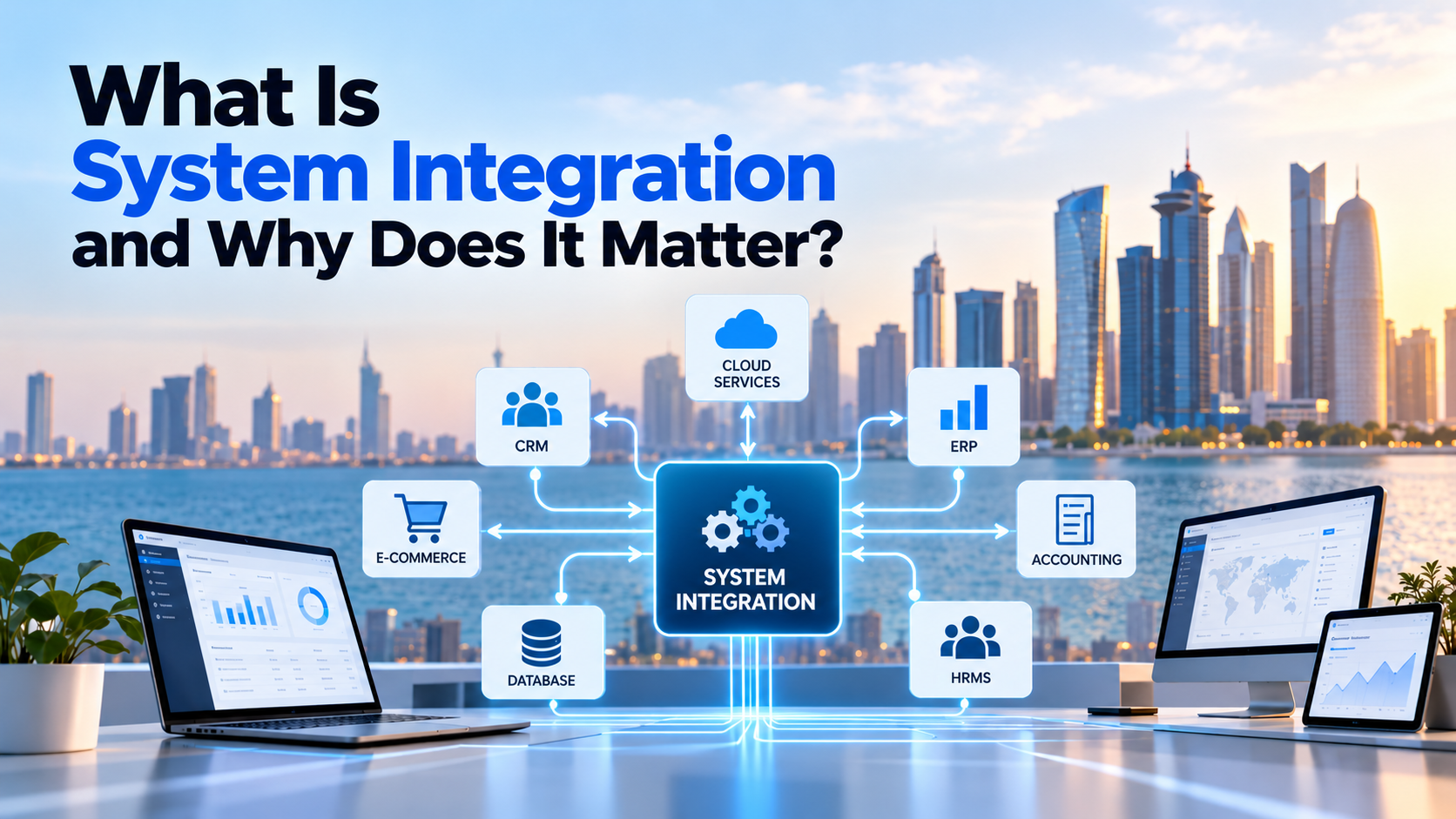
API integration connects applications through their APIs. System integration is a broader discipline that can also include databases, middleware, messaging systems, infrastructure, and business processes. API integration often forms one part of a wider system integration strategy.
Can API integration connect different ERP and CRM platforms?
Yes, provided the platforms expose suitable APIs or support another integration method. The implementation must account for data mapping, access permissions, conflicting records, and differences in business workflows.
Is API integration secure?
API integration can be secure when developers implement appropriate authentication, access controls, encryption, monitoring, and error handling. Security depends on the design, configuration, operating environment, and ongoing maintenance.
How long does API integration take?
The timeline depends on application compatibility, API documentation, workflow complexity, testing requirements, and third-party dependencies. A straightforward connection may take considerably less time than a multi-system enterprise integration. A technical assessment provides a more reliable estimate.
Do small businesses in Doha need API integration?
Small businesses can benefit when disconnected applications create repetitive work, data inconsistencies, or customer service delays. A focused integration between two essential systems can provide value without requiring a large-scale technology transformation.
Connect Your Business Systems with Inspire Technology
Disconnected applications can limit productivity, delay decisions, and create unnecessary operational work. API integration gives businesses a practical way to connect software, automate information exchange, and build more coordinated digital workflows.
Inspire Technology helps businesses explore integration approaches that fit their operational needs, existing applications, and growth plans.
Explore our API integration solutions to discuss your integration requirements and identify a suitable path towards more connected business operations.