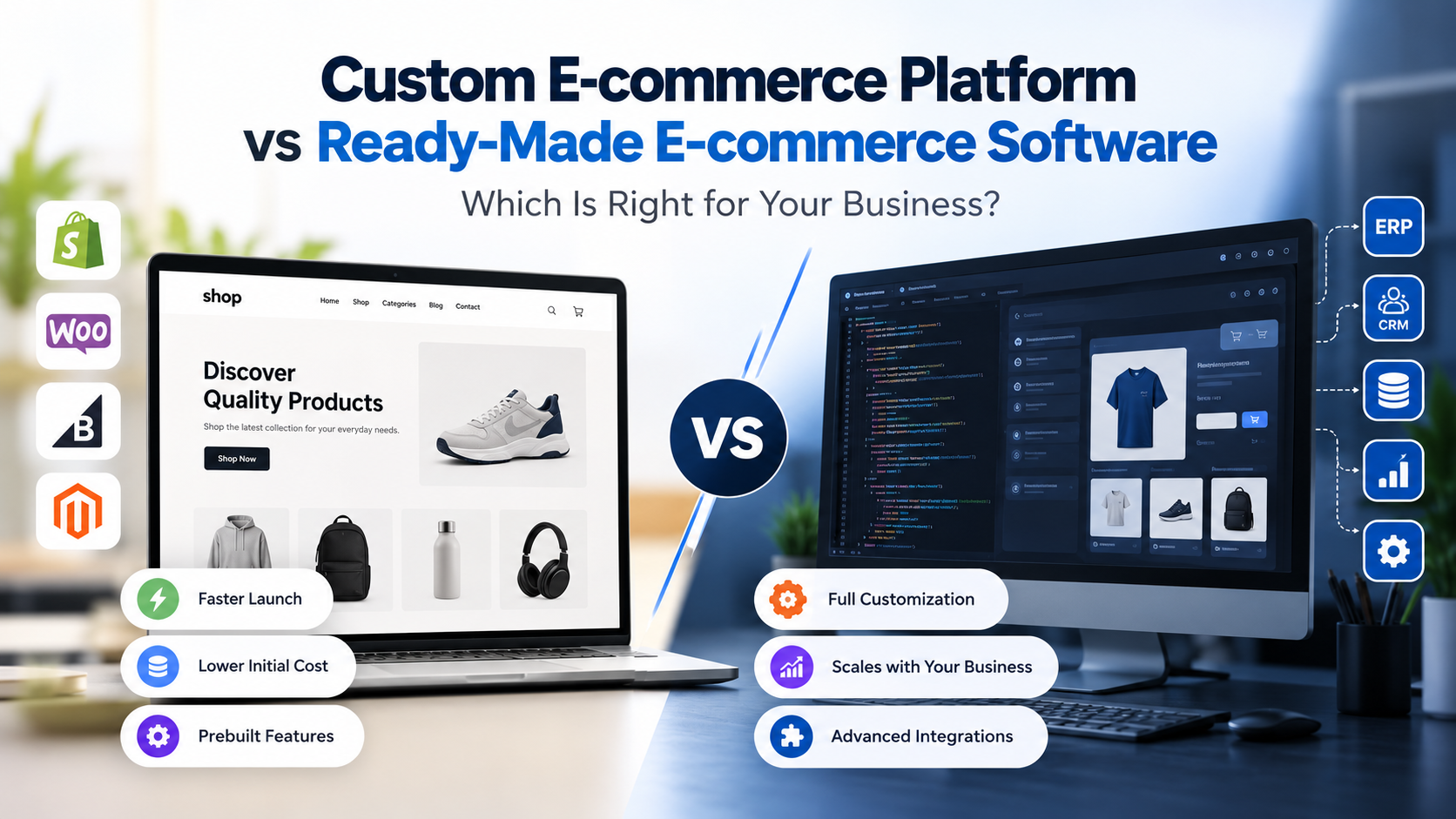

Choosing between a custom ecommerce platform and ready-made ecommerce software affects your development costs, daily operations, customer experience, and ability to scale. The right choice depends on how your business sells products, manages orders, connects systems, and plans for growth.
Ready-made platforms such as Shopify and WooCommerce help businesses launch online stores quickly. A custom ecommerce platform offers greater control over specialised workflows, integrations, and business logic. A hybrid approach can also combine an existing commerce platform with custom functionality.
Quick answer: Ready-made ecommerce software is generally suitable for businesses with standard selling requirements and a limited need for custom functionality. A custom ecommerce platform is worth considering when specialised pricing, complex integrations, or unique operational workflows exceed the practical capabilities of existing software. Compare both options using total cost of ownership, business requirements, integration needs, and maintenance responsibilities before making a decision.
What Is the Difference Between Custom and Ready-Made E-commerce Software?
A custom ecommerce platform is developed around specific business requirements, whereas ready-made ecommerce software provides prebuilt features that businesses can configure and extend.
The main difference lies in how much control a business needs over the underlying system and how much existing functionality it can reuse.
| Comparison factor | Custom ecommerce platform | Ready-made ecommerce software |
| Initial investment | Usually higher | Usually lower |
| Time to launch | Typically longer | Typically shorter |
| Functionality | Designed around defined requirements | Uses built-in features and extensions |
| Integrations | Can be designed around specific data flows | Depends on available connectors, APIs, and extensions |
| Scalability | Architecture can reflect specific workloads | Depends on platform capabilities and configuration |
| Maintenance | Requires a defined development and support plan | Provider manages some components; the business manages others |
| Technical control | Depends on ownership, architecture, and contracts | Often constrained by the provider’s ecosystem |
| Best suited for | Differentiated workflows and complex operations | Standard commerce requirements and faster launches |
Neither option is automatically better. A ready-made platform may support a substantial ecommerce operation, while a custom system may introduce unnecessary costs if the business only needs standard product listings, checkout, payments, and order management.
Which Ecommerce Approach Fits Your Business?
Use the following decision matrix to identify the most practical starting point.
| Business situation | Recommended starting point | Reason |
| New store selling standard products | Ready-made software | Existing commerce features reduce development work |
| Small business validating market demand | Ready-made software | Faster launch supports early testing |
| Established retailer with manageable requirements | Ready-made or hybrid | Existing features may cover most operational needs |
| B2B business with negotiated pricing and approval workflows | Ready-made, hybrid, or custom | The choice depends on how complex the rules are |
| Marketplace with specialised vendor operations | Ready-made or custom | Evaluate vendor management, commissions, permissions, and settlement requirements |
| Business with disconnected internal systems | Custom integrations or hybrid architecture | Targeted integration may solve the problem without rebuilding the storefront |
| Business requiring complete control over specialised workflows | Custom development | The architecture can reflect defined business processes |
Treat these recommendations as starting points, not universal rules. A well-configured commercial platform can support complex B2B and marketplace requirements. Test the available capabilities before deciding that custom development is necessary.
What Is a Custom Ecommerce Platform and How Does It Work?
A custom ecommerce platform is an online commerce system built around a company’s products, customers, workflows, and technical requirements.
Developers can define how the storefront, product catalog, shopping cart, checkout, inventory, and backend systems interact. The platform may also include specialised administration tools for sales teams, warehouse staff, suppliers, and business customers.
Common capabilities include:
- Customer-specific pricing and discounts
- Minimum order quantities and bulk purchasing
- Custom product configurators
- Multi-vendor marketplace functionality
- Multi-warehouse inventory management
- Automated order processing and fulfilment
- ERP and CRM integrations
- Account-based purchasing and approval workflows
- Tailored reporting and business intelligence
For example, a wholesale distributor may offer different prices to different customer accounts. Some customers may also require minimum order quantities, credit terms, or internal purchasing approvals.
A custom platform can incorporate these rules into the ordering process rather than depend on multiple extensions and manual workarounds.
However, custom development requires careful planning, testing, documentation, security controls, and ongoing maintenance. Greater flexibility is useful only when it solves a genuine business requirement.
What Is Ready-Made Ecommerce Software?
Ready-made ecommerce software provides prebuilt functionality that businesses can configure to launch and manage an online store.
Popular options include Shopify, WooCommerce, BigCommerce, and Adobe Commerce. Each offers different capabilities, hosting arrangements, customisation options, integrations, and technical responsibilities.
Businesses can select a theme, add products, configure payment methods, establish shipping rules, and manage orders without building every component from scratch.
Typical features include:
- Product and category management
- Shopping carts and checkout
- Payment gateway integrations
- Inventory and order management
- Customer accounts
- Discounts and promotional codes
- Responsive storefront themes
- Analytics and reporting integrations
- Extensions for marketing and customer support
The main advantage is speed. Businesses can reuse established functionality instead of funding a complete development project.
Limitations may arise when specialised requirements depend on paid applications, custom plugins, restricted APIs, or platform-specific workarounds.
The important question is whether the available features can support your business efficiently, both today and as your requirements evolve.
Which Ecommerce Option Costs Less Over Time?
Ready-made software generally requires less initial development work, but the total cost depends on subscriptions, applications, customisation, integrations, and maintenance. Custom development typically requires a larger initial investment, followed by costs for hosting, support, infrastructure, and future enhancements.
Compare the following cost categories before making a decision.
| Cost category | Ready-made software | Custom ecommerce platform |
| Initial setup | Configuration, theme setup, and implementation | Discovery, design, architecture, and development |
| Recurring fees | Subscription, hosting where applicable, and application fees | Hosting, infrastructure, licences, and support |
| Custom functionality | Extensions, applications, or additional development | Purpose-built features and ongoing maintenance |
| Integrations | Existing connectors or custom integration work | Custom connectors where required |
| Future changes | Platform constraints and application compatibility | Development, testing, and deployment |
| Migration | Export capabilities and source-platform limitations | Data mapping, import, validation, and migration tooling |
| Internal labour | Platform administration and application management | Technical oversight, product management, and support |
The actual cost depends on the platform, project scope, existing infrastructure, and the business’s technical requirements. Neither option guarantees lower long-term expenditure.
How Should You Calculate Total Cost of Ownership?
Compare both approaches across the same three-year period using actual vendor quotes and realistic development and maintenance estimates.
Include:
- Initial implementation and configuration.
- Subscriptions, hosting, and software licences.
- Custom features and integrations.
- Security updates, maintenance, and technical support.
- Staff time spent managing workarounds.
- Migration costs and future enhancements.
For a fair comparison, separate essential requirements from optional features. Estimate the cost of each approach against the same functional scope.
A ready-made platform may remain more economical if its existing features meet your needs. A custom solution may offer better value when it replaces expensive workarounds or resolves recurring operational problems. Validate that business case before committing to a build.
Example: A Wholesale Distributor Choosing an Ecommerce Platform
Consider an illustrative wholesale distributor that manages hundreds of products, negotiated customer prices, minimum order quantities, multiple warehouses, and ERP-based inventory updates.
The team should first evaluate whether a ready-made platform can support these requirements through native functionality and reliable integrations.
If the platform handles pricing, inventory, ordering, and ERP synchronisation without excessive workarounds, custom development may add unnecessary expense.
If the business repeatedly encounters pricing errors, stock discrepancies, or manual order-processing bottlenecks, the team should investigate targeted integrations or a hybrid architecture. A fully custom platform becomes more compelling only if the existing system cannot meet essential requirements reliably and the expected benefits justify the cost.
The lesson: Choose the architecture that solves the documented business problem, not the one that sounds most sophisticated.
When Do You Need Custom Ecommerce Features?
Custom ecommerce development becomes more valuable when standard software cannot support important business processes efficiently.
Consider custom functionality when your business needs:
Customer-specific pricing: Different customer accounts require negotiated prices, contract terms, or conditional discounts.
Complex order rules: Minimum quantities, purchasing approvals, bundled products, or product configurations affect how orders are processed.
Specialised integrations: ERP, CRM, accounting, inventory, and fulfilment systems must exchange data using rules that existing connectors cannot reliably support.
Unique customer journeys: Your business needs product selection, checkout, or account functionality that available themes and extensions cannot reasonably deliver.
Operational automation: Teams spend excessive time reconciling records, correcting orders, or transferring information between disconnected applications.
Before funding a custom build, document the limitations, estimate their operational impact, and compare the cost of improving the current platform with the cost of developing a replacement.
Which Ecommerce Platform Is Better for Business Growth?
Neither custom nor ready-made ecommerce software is inherently more scalable. Ready-made platforms can support substantial growth when their capabilities match the business requirements. Custom platforms provide more architectural control when specialised workloads or integrations demand it.
Growth can involve higher traffic, larger product catalogs, more orders, additional warehouses, international expansion, or more complex business operations.
A platform assessment should consider:
- Expected concurrent visitors and peak traffic
- Product catalog size and variant complexity
- Orders processed during peak periods
- Inventory synchronisation requirements
- Search and filtering demands
- Geographic distribution of customers
- Availability and recovery requirements
A custom platform can be designed around caching, database queries, background processing, search infrastructure, and integration workloads. However, poor engineering can still cause bottlenecks.
Ready-made software may already provide sufficient capacity and managed infrastructure for a growing retailer. Check the provider’s documented capabilities, service limits, and available support before assuming a rebuild is necessary.
The right approach is to establish measurable performance requirements and test the proposed architecture against them.
Can Ecommerce Software Integrate with ERP and CRM Systems?
Yes. Ecommerce platforms can connect with ERP, CRM, accounting, payment, inventory, and logistics systems through native integrations, extensions, APIs, middleware, or custom development.
Ready-made platforms work well when existing connectors support the required data flows. Custom integration becomes useful when the business needs specialised synchronisation, validation, permissions, or transaction handling.
Consider an online order that must pass through several systems:
- Validate customer pricing and available inventory.
- Send the order to the ERP system.
- Reserve stock at the appropriate warehouse.
- Synchronise payment and fulfilment status.
- Notify the customer when the order ships.
Reliable integration must also handle failed requests, duplicate events, delayed responses, and conflicting stock updates.
Before choosing an architecture, define data ownership, synchronisation frequency, error handling, access permissions, and recovery procedures.
A targeted integration project may resolve these problems without replacing the entire ecommerce platform. Businesses should assess that option before committing to a full custom build.
Which Ecommerce Platform Is Better for SEO?
Neither custom nor ready-made ecommerce software automatically ranks better. Search performance depends on technical implementation, site architecture, crawlability, useful content, product information, and customer experience.
Ready-made platforms can support important SEO requirements, including editable metadata, product URLs, redirects, and content publishing. Available functionality varies by platform, configuration, and installed extensions.
Custom development offers greater control over how developers implement technical SEO requirements, but that control also creates responsibility for correct implementation.
Important considerations include:
- Logical category and subcategory structures
- Descriptive, stable product URLs
- Appropriate canonical tags
- Crawlable internal links
- XML sitemaps
- Product and breadcrumb structured data
- Mobile-friendly layouts
- Fast-loading product pages
- Indexing controls for filtered and duplicate URLs
- Accurate product and variant information
For example, product filters may generate many URL combinations. Without an indexing strategy, those URLs can create unnecessary crawl demands or duplicate-content concerns.
Google recommends clear site navigation and crawlable internal links so search engines can discover important ecommerce pages. Its official guidance also explains how product data and structured data help Google understand ecommerce content.
Read Google’s ecommerce SEO best practices before finalising the technical requirements.
For a broader explanation of site architecture and development considerations, read our ecommerce web development guide.
Which Approach Offers Better Security and Data Control?
Neither approach is automatically more secure. Security depends on implementation, configuration, access controls, maintenance, and operational practices.
Ready-made platforms may provide managed infrastructure, core software updates, and established payment integrations. Businesses must still protect administrator accounts, configure permissions, manage third-party applications, and follow applicable data-protection requirements.
Custom platforms provide more control over architecture, data flows, infrastructure, and access policies. They also place greater responsibility on the business and its technical team.
Security planning should cover:
- Role-based access control and multi-factor authentication
- Encryption in transit and appropriate protection of stored data
- Secure session management and input validation
- Dependency updates and vulnerability management
- Logging, monitoring, and incident response
- Backups and disaster recovery
- Payment-provider integration and relevant compliance obligations
Data ownership and portability also matter. A custom platform may offer source-code access and greater architectural freedom, but ownership depends on contracts, licences, hosting, and third-party dependencies.
A ready-made platform may create dependence on its APIs, pricing, and ecosystem. Migration can require data exports, URL redirects, integration changes, and storefront redevelopment.
Before committing, clarify who owns the code and data, who maintains integrations, what documentation will be supplied, and how the business can migrate if its needs change.
Can You Start with Ready-Made Software and Move to Custom Later?
Yes. A business can start with ready-made ecommerce software and migrate to a custom platform or hybrid architecture when its requirements justify the change.
A phased approach can help businesses validate demand before funding more complex development. However, migration requires planning.
Assess:
- Product, customer, and order data portability
- URL redirects and search visibility
- Customer accounts and authentication
- Payment and fulfilment workflows
- ERP, CRM, and inventory integrations
- Analytics and reporting continuity
- Testing, launch monitoring, and rollback procedures
Do not assume migration will be simple or inexpensive. Evaluate the source platform’s export capabilities and document the destination architecture before setting a launch date.
A business may also find that targeted custom integrations solve its immediate problems. Replacing the entire platform should remain an option rather than an automatic next step.
How Should You Choose the Right Ecommerce Platform?
Use this six-step framework to make a decision based on requirements and evidence.
1. Document Business Requirements
List the essential features, workflows, user roles, integrations, reporting needs, and security obligations. Separate launch requirements from potential future enhancements.
2. Test Ready-Made Platforms
Evaluate relevant platforms against realistic scenarios. Test checkout, pricing, inventory updates, customer permissions, and integration capabilities rather than relying solely on feature lists.
3. Compare Three-Year Costs
Include implementation, subscriptions, applications, customisation, hosting, maintenance, migration, and internal labour. Use actual quotes wherever possible.
4. Evaluate Technical and Operational Risks
Identify API limitations, third-party dependencies, data portability concerns, performance requirements, and potential migration challenges.
5. Measure the Cost of Workarounds
Estimate the time and money spent on manual processes, integration failures, and platform limitations. Identify which issues a custom solution would actually resolve.
6. Select the Simplest Suitable Architecture
Choose ready-made software if it meets your needs at a sustainable cost. Consider hybrid or custom development when specific requirements justify the additional investment and maintenance responsibilities.
The best architecture solves the business problem without introducing unnecessary complexity.
Frequently Asked Questions
Is a custom ecommerce platform worth the investment?
A custom ecommerce platform may be worth the investment when it enables essential business capabilities, resolves costly operational problems, or reduces persistent workarounds. Compare the expected benefits against development, integration, maintenance, and migration costs before committing.
Is Shopify better than a custom ecommerce platform?
Shopify may be better for businesses that need established commerce features, a faster launch, and managed infrastructure. A custom platform may suit businesses with specialised workflows or integration requirements that existing solutions cannot support efficiently. Evaluate actual requirements before choosing.
Can a small business benefit from custom ecommerce development?
Yes, but custom development is not necessary for every small business. It may be appropriate when a smaller company operates a specialised business model or needs functionality that existing platforms cannot reasonably provide. Businesses with standard selling requirements can often begin with ready-made software.
Is a hybrid ecommerce architecture better than a fully custom platform?
A hybrid architecture can be suitable when an existing platform handles standard commerce functions well but the business needs custom integrations or specialised services. It can avoid rebuilding existing capabilities, although integration and maintenance responsibilities remain.
What should a business prepare before requesting an ecommerce development quote?
Prepare a requirements list, product and order volumes, user roles, integration requirements, data migration needs, security obligations, expected launch date, and budget range. Clear requirements help a development team estimate scope, costs, dependencies, and delivery risks.
When should a business replace its existing ecommerce platform?
Consider replacement when documented limitations create significant business costs, essential requirements cannot be supported reliably, or ongoing risks outweigh migration costs. Evaluate configuration improvements and targeted integrations before replacing the entire system.
Does a custom ecommerce platform improve SEO rankings?
Custom development can provide greater control over site architecture, rendering, URLs, performance, and technical SEO implementation. It does not guarantee higher rankings. Content quality, crawlability, competition, product information, and customer experience also affect search performance.
How long does custom ecommerce development take?
The timeline depends on scope, design, integrations, data migration, testing, and security requirements. A relatively simple project may take a few months, while complex enterprise systems can require substantially longer. A reliable estimate requires a discovery and planning phase.
Conclusion: Choose the Ecommerce Architecture That Fits Your Business
Ready-made ecommerce software offers a practical route to market when existing features support your products, payments, inventory, and customer journeys. Custom ecommerce development offers greater control when specialised workflows, complex integrations, or operational requirements justify a tailored architecture.
The decision should reflect total cost of ownership, technical requirements, business priorities, and long-term maintenance. Avoid paying for unnecessary complexity, but do not allow persistent platform limitations to restrict a sound business strategy.
Need Help Evaluating Your Ecommerce Platform Options?
Before investing in a new platform, identify the workflows, integrations, and technical limitations that matter most to your business.
Inspire Technology can help you assess your ecommerce requirements, evaluate suitable architecture options, identify integration needs, and define the scope of a potential development project.
Explore our e-commerce platform development services to discuss a solution aligned with your business model, operational requirements, and growth plans.