
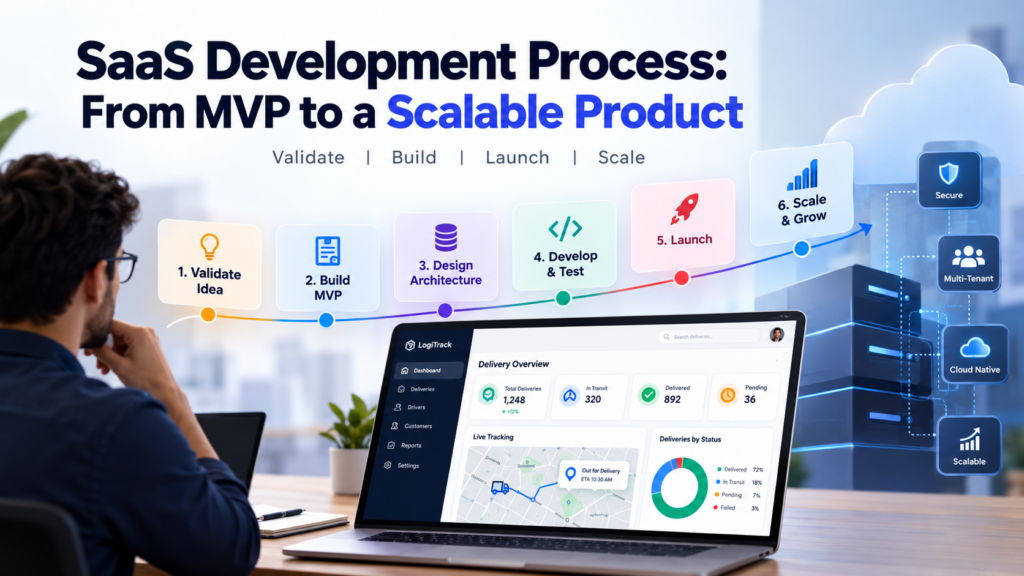
Your SaaS idea has potential. But how do you turn it into a product customers trust, use regularly, and pay for as your business grows?
The answer goes beyond writing code. A successful SaaS development process connects customer research, product strategy, software architecture, security, deployment, and continuous improvement. Every decision should move the product closer to a clear business outcome.
Consider a logistics company that wants to replace spreadsheets with a delivery management platform. The initial idea includes delivery tracking, driver management, customer notifications, analytics, and automated reporting. Building everything at once could consume months of development before the company knows which features customers value most.
A better approach starts with one important workflow, validates demand, and expands the product through evidence-led development.
This guide explains how to develop a SaaS product from minimum viable product (MVP) to scalable platform, how to make architectural decisions that are difficult to reverse, and how to avoid unnecessary complexity as your customer base grows.
What Is the SaaS Development Process?
The SaaS development process is the end-to-end journey of researching, designing, building, launching, maintaining, and improving software delivered over the internet.
Software as a service (SaaS) typically runs on infrastructure managed by the provider. Customers access the application through a browser or another supported interface, while the provider manages software updates, hosting, security controls, and ongoing operations.
A SaaS product usually combines six essential components:
- Frontend: The interface customers use to complete tasks and manage their accounts.
- Backend: The application logic that processes requests, enforces business rules, and coordinates services.
- Database and storage: The systems that store customer records, transactions, documents, and other application data.
- Identity and access management: Authentication and permissions that control who can access specific resources.
- Billing and subscriptions: The systems that manage plans, payments, invoices, and usage limits where applicable.
- Cloud infrastructure: The computing, networking, monitoring, and deployment resources that keep the application available.
The complexity depends on the product. A simple appointment scheduling platform needs a different architecture from a financial management system that processes sensitive transactions across multiple organisations.
The development process must reflect those differences rather than follow a rigid template.
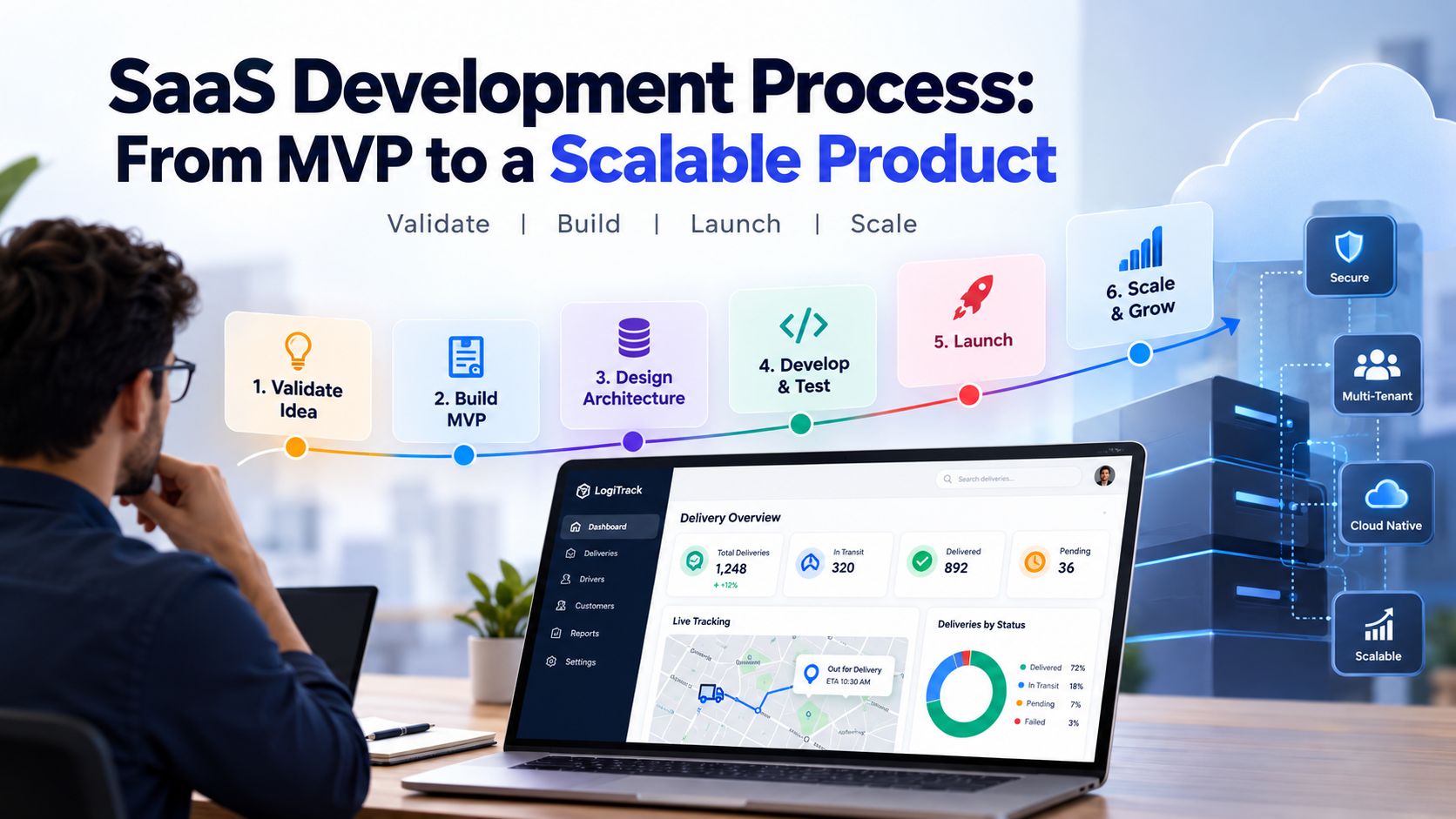
The SaaS Development Roadmap: From Idea to Scalable Product
A reliable SaaS development lifecycle follows a sequence of decisions. Teams can revisit earlier stages as requirements change, but each stage should produce evidence that informs the next investment.
1. Validate the Customer Problem Before Building
The first question is not which features to develop. It is which customer problem deserves a solution.
Product discovery helps businesses understand their target audience, existing alternatives, buying decisions, and unmet needs before committing to a development budget.
Start with four activities:
- Interview prospective customers about their current workflows and frustrations.
- Review competing products and identify specific gaps.
- Define the outcome that would make customers consider switching.
- Test willingness to pay through interviews, demonstrations, pilot commitments, or other appropriate validation methods.
Illustrative example: A logistics SaaS startup discovers that delivery managers spend hours each day reconciling delivery records from spreadsheets, messaging applications, and driver reports.
The original concept includes fleet management, route optimisation, inventory control, and predictive analytics. Customer interviews reveal that delivery visibility and reliable reporting are the immediate priorities.
That evidence changes the initial product scope.
Instead of building a broad logistics platform, the team can start with delivery status tracking and a centralised reporting dashboard.
Business outcome: A narrower, validated problem helps the company focus its budget on a product customers have a reason to adopt.
2. Define an MVP That Solves One Meaningful Problem
A minimum viable product is the smallest usable version of a product that can deliver its core value and test important business assumptions.
It is not simply a prototype or an unfinished application. Customers should be able to complete a meaningful task and provide feedback based on real use.
For the logistics example, the initial scope could include:
| Essential MVP capability | Why it matters |
| Organisation registration | Allows a business to create its workspace |
| User authentication | Protects access to customer accounts |
| Delivery status management | Supports the core operational workflow |
| Basic reporting dashboard | Gives managers visibility into delivery records |
| Role-based permissions | Limits access according to user responsibilities |
| Error monitoring and backups | Supports reliable operation and recovery |
Advanced route optimisation, predictive analytics, extensive integrations, and custom reporting can remain outside the first release if customer research does not establish them as essential.
However, security, data integrity, and operational safeguards are not optional simply because a product is an MVP.
Before development begins, define the evidence that will determine whether the product succeeds. Suitable measures may include successful workflow completion, repeat usage, customer retention, trial-to-paid conversion, and willingness to pay.
Business outcome: The MVP creates an opportunity to validate demand before the company commits to a larger product investment.
For a broader discussion of software investment decisions, see custom software vs off-the-shelf software.
3. Choose an Architecture That Supports the Next Stage of Growth
The architecture determines how the application handles data, executes business logic, integrates with other systems, and responds to increased demand.
The objective is not to predict every future requirement. It is to create a manageable technical foundation that supports the product’s current scope without blocking likely changes.
For many early SaaS products, a modular monolith is a practical starting point. It keeps related application components in one deployable system while preserving clear boundaries between business functions.
Microservices may become appropriate when specific components require independent deployment, scaling, or ownership. However, distributed services also introduce network communication, observability, deployment, and operational challenges.
The decision should reflect demonstrated needs rather than assumptions about future traffic.
Consider these architectural priorities:
- Domain boundaries: Separate important business functions, such as delivery management, billing, and reporting.
- Database design: Define data relationships, indexes, constraints, and migration practices.
- API contracts: Establish predictable interfaces for the frontend and external integrations.
- Background jobs: Process suitable tasks asynchronously instead of making users wait for lengthy operations.
- Observability: Capture application errors, performance metrics, and relevant logs.
- Deployment: Establish repeatable release and rollback procedures.
The business benefit is straightforward: clear boundaries make future changes easier to assess and reduce the risk that one feature creates unexpected problems elsewhere.
Inspire Technology’s custom software development services can help businesses plan software architecture around their operational requirements and growth objectives.
4. Design Multi-Tenant SaaS Architecture Around Customer Isolation
A multi-tenant SaaS application serves multiple customers through a shared platform while maintaining appropriate separation between their data, users, settings, and permissions.
In a business-to-business product, each tenant usually represents a customer organisation. Employees within that organisation access the resources permitted by their roles.
The tenancy model influences database design, infrastructure costs, access control, customer onboarding, and future maintenance.
Three common approaches are:
| Tenancy model | How it works | Main trade-off |
| Shared database and schema | Tenants use shared tables, with records associated with tenant identifiers | Efficient resource use, but application-level isolation requires rigorous controls |
| Shared database with separate schemas | Tenants have separate database schemas | Greater logical separation, with additional schema management |
| Separate database per tenant | Each tenant has a dedicated database | More isolation options, but potentially higher operational costs |
Hybrid models are also possible. Some SaaS products use shared infrastructure for standard customers and dedicated resources for customers with specific contractual, regulatory, or performance requirements.
There is no universal best model. The decision depends on data sensitivity, customer expectations, regulatory obligations, operating costs, and the level of isolation the product must provide.
Apply the isolation rule across the entire application.
A database query is only one part of the security boundary. APIs, file storage, background jobs, caches, exports, and administrative tools must also enforce tenant-aware access controls.
For example, a manager from Company A must not retrieve Company B’s delivery records by changing a record identifier in an API request.
A secure implementation should include automated cross-tenant access tests, permission checks, audit logging where appropriate, and tested procedures for tenant onboarding and account termination.
Microsoft’s multitenant architecture guidance provides additional detail on these architectural trade-offs.
Business outcome: Proper tenant isolation protects customer trust and helps the platform support multiple organisations without compromising data boundaries.
5. Build, Test, and Release in Small Development Cycles
Once the requirements and architecture are defined, the development team can implement the product in manageable increments.
A typical cycle includes requirement selection, implementation, code review, automated testing, staging deployment, feedback, and controlled release.
The team should establish a reliable engineering workflow early rather than introduce quality controls after the application becomes difficult to change.
Important practices include:
- Version control and code reviews.
- Automated unit and integration tests.
- Continuous integration and continuous delivery (CI/CD).
- Database migration procedures.
- Separate development, staging, and production environments where appropriate.
- Dependency updates and secret management.
- Documented release and rollback procedures.
AI-assisted development tools can help engineers generate test cases, explain unfamiliar code, and accelerate routine tasks. However, generated code still requires appropriate review, testing, and security assessment.
For the logistics MVP, a change to delivery status should not accidentally break reporting or expose another organisation’s records. Automated tests should cover those relationships before the change reaches production.
Business outcome: Smaller releases make defects easier to isolate, support faster feedback, and reduce the risk associated with large deployments.
6. Design the Product Around Customer Adoption
A SaaS application can contain the right features and still fail to retain customers if its interface creates unnecessary friction.
The product experience should help users reach a meaningful outcome quickly.
Focus on the complete user journey, from registration to the first successful task. Review navigation, onboarding, form design, permissions, empty states, error messages, and mobile usability.
For example, a logistics manager should not need extensive training to understand how to register a delivery, update its status, or generate a report.
A guided onboarding process, clear dashboard labels, useful validation messages, and sensible defaults can reduce the effort required to adopt the product.
Measure activation through meaningful actions rather than registration alone. A new account is a weak signal if the customer never completes the workflow that motivated the purchase.
Collect feedback through usability testing, support requests, product analytics, and customer interviews. Use those findings to prioritise changes.
Business outcome: A clearer user experience can reduce onboarding friction and help customers discover the value of the product sooner.
7. Connect Subscription Billing to Product Permissions
SaaS pricing affects application design because the commercial model determines which features customers can access, how usage is measured, and how accounts change when subscriptions are updated.
Common models include monthly or annual subscriptions, tiered plans, seat-based pricing, usage-based pricing, and enterprise agreements.
The implementation may require:
- Checkout and payment-provider integration.
- Subscription status management.
- Invoice and payment records.
- Feature entitlements and usage limits.
- Failed-payment and renewal handling.
- Upgrade, downgrade, and cancellation workflows.
- Secure processing of payment events.
Suppose the logistics platform offers a basic plan with limited users and a premium plan with advanced reporting. The backend must enforce those limits consistently, even if a user attempts to bypass the interface through an API request.
Billing integrations also need to handle duplicate or delayed webhook events, failed renewals, and changes to subscription status.
The product team should define the relationship between billing status and customer access before launch. Payment-provider integration alone does not create a complete subscription management system.
Business outcome: A clear connection between pricing, entitlements, and usage makes the product easier to operate and helps avoid inconsistent customer experiences.
8. Verify Security, Performance, and Recovery Before Launch
A product that works during development may behave differently under real customer workloads.
Testing should verify that the application performs its essential tasks, protects sensitive information, and recovers appropriately from failures.
The release checklist should cover:
- Functional and integration testing.
- Authentication and authorisation.
- Cross-tenant data isolation.
- Input validation and dependency security.
- Performance under expected workloads.
- Error tracking and alerting.
- Backup restoration and recovery procedures.
- Accessibility of essential user journeys.
Performance testing should reflect realistic activity. For example, several customers generating reports simultaneously may place a different load on the database than individual users browsing a dashboard.
Define suitable service-level objectives for response times, availability, and error rates according to the product’s requirements. Establish alerts for failures that could materially affect customers.
Security requirements should also reflect the data and industry involved. Healthcare, financial services, and other regulated environments may require additional controls and assessments.
Business outcome: Pre-launch testing provides evidence that the product is ready for its intended workload and risk profile.
9. Launch With a Controlled Rollout
A production launch introduces real users, real data, and operational responsibilities. The release plan should prepare the business to handle feedback and incidents rather than focus solely on making the application available.
A limited beta can help the team validate onboarding, identify defects, and observe real usage before expanding access.
Before launch, verify the following:
- Production configuration and deployment procedures.
- Monitoring, logging, and error alerts.
- Tested backups and recovery arrangements.
- Customer support and incident escalation.
- Privacy information and relevant security documentation.
- Billing and account-management workflows.
- Product analytics and defined success measures.
For the logistics platform, the initial release might serve a small group of delivery teams. Their feedback could reveal missing status options, unclear reports, or workflow gaps that were not obvious during development.
The team can address critical issues before a wider release.
Business outcome: A controlled launch reduces avoidable risk and creates a structured feedback loop for product improvement.
A Practical SaaS Scaling Framework: What to Fix, What to Measure, and What to Delay
The most expensive SaaS mistakes often come from making a major technical investment before the business understands the actual requirement.
Use three questions to guide decisions as the product grows.
What must be established early?
Prioritise decisions that affect security, data integrity, and the ability to change the product safely.
These usually include tenant boundaries, authentication, authorisation, database integrity, API contracts, backup strategy, and deployment practices.
Changing these foundations after customers depend on them can require data migrations, service interruptions, or substantial rework.
What should be measured before changing?
Measure the actual behaviour of the system before investing in major optimisation.
| Observed signal | What to investigate first |
| Slow dashboard requests | Query performance, indexes, payload size, and caching |
| Increasing infrastructure costs | Resource utilisation, workload patterns, and cost per tenant |
| Failed background jobs | Retry behaviour, queue capacity, and error handling |
| Poor user activation | Onboarding friction and the value of the core workflow |
| Rising customer churn | Customer feedback, product fit, support issues, and missing capabilities |
| Frequent release failures | Test coverage, deployment procedures, and rollback readiness |
These signals do not automatically identify the cause. They indicate where investigation should begin.
For instance, slow reporting may result from an inefficient database query rather than insufficient server capacity. Adding more infrastructure without investigating the query could increase costs without solving the underlying problem.
What can wait until the evidence is clear?
Some capabilities can evolve after the product has established demand.
Examples include advanced analytics, extensive customisation, additional integrations, complex automation, and the separation of application components into independent services.
The logistics platform may initially run successfully on a modular monolith. If reporting later creates a distinct workload with different scaling requirements, the team can assess whether asynchronous processing, a dedicated reporting component, or another architectural change would offer measurable benefits.
This approach creates a practical rule for SaaS product development:
Establish security and data foundations early. Measure operational constraints. Expand the architecture when real requirements justify the cost.
Common SaaS Development Mistakes and How to Avoid Them
A focused development strategy helps businesses avoid several expensive mistakes.
Building too much before validating demand. A large feature set increases development effort without proving that customers want the product. Start with a meaningful workflow and expand through evidence.
Treating security as a final checklist. Late discovery of access-control or tenant-isolation problems can force substantial redesign. Address security requirements throughout development.
Choosing microservices too early. Distributed architectures introduce additional operational responsibilities. Begin with an architecture suited to the team’s needs and revisit the decision when evidence supports a change.
Ignoring operating costs. Hosting, monitoring, third-party integrations, support, and maintenance affect SaaS profitability. Model recurring expenses alongside development costs and expected revenue.
Launching without measurable goals. Sign-ups alone do not demonstrate product success. Track activation, retention, usage, and commercial performance alongside technical health.
Scaling without identifying the bottleneck. Measure application behaviour before making expensive infrastructure changes. Optimisation should address an observed constraint.
Failing to plan maintenance. A SaaS product requires ongoing dependency updates, security reviews, incident response, backups, and product improvements after launch.
For more guidance on investment planning, read Inspire Technology’s software development cost guide for Qatar.
How Inspire Technology Supports SaaS Development
Turning a SaaS idea into a reliable product requires more than implementation. Businesses need a clear scope, an appropriate architecture, a usable interface, reliable integrations, and a plan for ongoing operations.
Inspire Technology’s SaaS development services cover product development, multi-tenant architecture, UI/UX design, API integrations, subscription systems, migration, and ongoing maintenance.
The right approach depends on your starting point.
- For startups: Define the core customer problem, prioritise the MVP, and establish the technical foundations for validation.
- For growing SaaS businesses: Investigate performance constraints, improve tenant isolation, refine integrations, and expand features based on customer needs.
- For established companies: Assess existing applications, plan migration or modernisation, and align the architecture with operational and security requirements.
A practical engagement should clarify the required workflows, target users, integration dependencies, data requirements, security expectations, and success criteria before the team commits to a detailed implementation plan.
For businesses in Qatar, those decisions should also reflect the needs of the intended market and any applicable contractual or regulatory requirements.
Planning a new SaaS product or preparing an existing platform for growth? Explore Inspire Technology’s SaaS development services to discuss your requirements, technical priorities, and development roadmap.
Frequently Asked Questions About SaaS Development
1. What are the main stages of the SaaS development process?
The main stages include problem validation, MVP planning, architecture design, user experience design, development, testing, deployment, and continuous improvement. Teams should revisit earlier decisions when customer feedback or technical evidence reveals new requirements.
2. How long does SaaS MVP development take?
The timeline depends on feature scope, integrations, design complexity, team capacity, and security requirements. Inspire Technology’s service page indicates that a focused SaaS product may take around three to four months, while larger systems require longer. A project-specific estimate should follow requirements analysis.
3. What should a SaaS MVP include?
A SaaS MVP should include the features required to solve the core customer problem. Depending on the product, these may include authentication, the primary workflow, data storage, essential administration, appropriate security controls, and monitoring. Advanced features should follow validated demand.
4. What is multi-tenant SaaS architecture?
Multi-tenant SaaS architecture allows multiple customer organisations to use a shared software platform while maintaining appropriate separation of their data and permissions. Common approaches include shared databases, separate schemas, dedicated databases, and hybrid models.
5. Should a SaaS product use a monolith or microservices?
A modular monolith often provides a manageable starting point for an early SaaS product. Microservices can help when specific components require independent scaling, deployment, or ownership. The decision should reflect actual workload, team capability, and operational requirements.
6. How can a SaaS product scale without a complete rebuild?
Start with clear application boundaries, reliable data models, automated testing, monitoring, and repeatable deployments. Measure performance before changing infrastructure. Database optimisation, caching, asynchronous processing, and targeted architectural changes can address specific constraints without requiring a complete rewrite.
7. How do you secure a multi-tenant SaaS application?
Enforce tenant-aware authorisation across APIs, databases, file storage, background jobs, and exports. Add cross-tenant access tests, appropriate encryption, secure credential management, monitoring, and tested recovery procedures. Additional controls may be necessary for sensitive or regulated workloads.
8. How much does SaaS development cost?
Costs depend on product complexity, MVP scope, integrations, team requirements, infrastructure, and security obligations. Businesses should consider initial development alongside hosting, maintenance, monitoring, support, and future improvements. A scoped technical assessment is the best basis for a meaningful estimate.
9. How do you know when a SaaS product is ready to scale?
Look for measurable evidence, such as sustained customer adoption, growing workload, performance constraints, increased operational costs, or requirements that the existing architecture cannot support efficiently. Validate the underlying cause before investing in a major redesign.
10. Can an existing application be converted into a SaaS product?
Yes, many applications can be adapted for SaaS delivery. The work may involve cloud migration, tenant isolation, authentication changes, subscription management, automated deployments, monitoring, and data migration. The required effort depends on the existing architecture and the intended service model.
11. Which technology stack is best for SaaS development?
There is no universally best technology stack. The decision should account for product requirements, team expertise, integration needs, hosting options, security, and long-term maintenance. A well-supported stack that the team can operate reliably is usually a stronger choice than technology selected purely for popularity.
12. What happens after a SaaS product launches?
Post-launch work includes monitoring, maintenance, security updates, incident response, customer support, and product improvements. Teams should use customer feedback and technical measurements to prioritise the next development cycle.
Build a SaaS Product That Can Grow With Your Business
A successful SaaS product does not need every feature on day one. It needs a clear customer problem, a useful initial solution, secure technical foundations, and a development strategy that responds to evidence.
Validate demand before expanding the scope. Establish architectural decisions that protect customer data and future flexibility. Measure real performance before investing in infrastructure. Then improve the product as customer needs and business requirements evolve.
Ready to move from SaaS idea to a defined development roadmap? Contact Inspire Technology through its SaaS development service page to explore the technical approach your product requires.