
Choosing the right ecommerce foundation decides how far your business can scale. A weak platform slows growth. A strong platform unlocks revenue, performance, and global expansion.
This guide breaks down WooCommerce vs Shopify vs custom ecommerce website development using real decision factors: cost, SEO, scalability, performance, control, and long-term ROI.
You will get a clear answer based on your business stage, technical needs, and growth goals.
Why Choosing the Right E-Commerce Platform Defines Your Business Growth
Every ecommerce platform controls core business metrics:
- Page speed
- Search rankings
- Conversion rates
- Customer experience
- Payment flexibility
- Security
- Scalability
A wrong platform leads to high rebuild cost, SEO loss, and performance issues. A correct platform builds a scalable ecommerce infrastructure that supports growth.
Key evaluation metrics:
- Ownership and control
- Total cost of ownership
- Customization flexibility
- SEO capability
- Performance optimization
- Global expansion readiness
Understanding the Core Platforms (Shopify, WooCommerce, Custom Development)
Shopify (Hosted SaaS Platform)
Shopify provides a fully hosted ecommerce system. Setup is quick. Hosting, security, and maintenance stay managed.
- Plug-and-play setup
- Monthly subscription model
- Built-in features
- Limited backend control
WooCommerce (Open-Source WordPress Plugin)
WooCommerce converts a WordPress website into an online store.
- Open-source flexibility
- Full control over files and hosting
- Large plugin ecosystem
- Requires maintenance
Custom Ecommerce Website Development
Custom ecommerce builds your platform from scratch.
- Full backend control
- Tailored integrations
- Custom UI/UX
- Scalable architecture
System types:
- Shopify → hosted
- WooCommerce → self-hosted
- Custom → fully controlled infrastructure
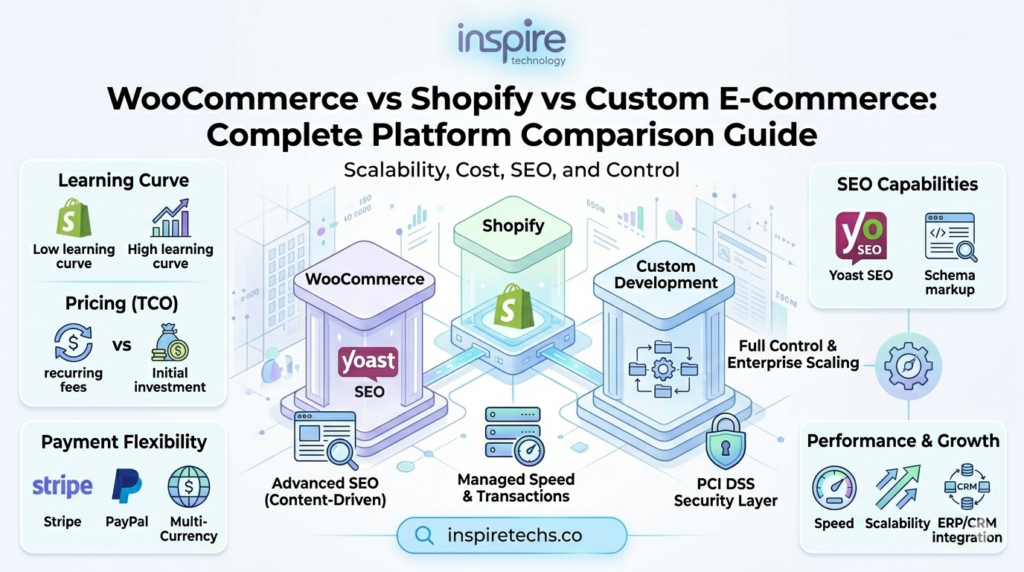
WooCommerce vs Shopify vs Custom — At a Glance Comparison
| Feature | Shopify | WooCommerce | Custom Development |
| Ease of Use | High | Medium | Low |
| Customization | Limited | High | Unlimited |
| SEO Control | Basic | Advanced | Full |
| Cost | Recurring | Flexible | High initial |
| Scalability | Managed | Hosting dependent | Built for scale |
| Ownership | Low | High | Full |
| Performance | Controlled | Configurable | Optimized |
Ease of Use and Learning Curve
Shopify
- Fast setup
- Beginner-friendly interface
- No technical setup required
WooCommerce
- Requires WordPress setup
- Moderate learning curve
- Developer-friendly
Custom Development
- Requires technical team
- Full system planning needed
Verdict:
- Beginners → Shopify
- Developers → WooCommerce
- Enterprises → Custom
Customization and Flexibility (Control Over Your Store)
WooCommerce
- Full theme customization
- Plugin-based architecture
- PHP, HTML, CSS, JavaScript control
Shopify
- Uses Liquid templating
- Restricted backend
- App dependency for features
Custom Ecommerce
- Full system control
- Custom logic and workflows
- Tailored checkout and integrations
Core differentiator:
- WooCommerce = flexible
- Shopify = structured
- Custom = unlimited
Pricing Breakdown and Total Cost of Ownership
WooCommerce Cost Structure
- Plugin: free
- Hosting: variable
- Themes: optional
- Plugins: scalable cost
- No platform transaction fees
Shopify Pricing
- Subscription: $29–$299+
- Apps: recurring cost
- Transaction fees: up to 2.9% + extra
- Hidden scaling costs
Custom Ecommerce Cost
- High initial investment
- Low long-term dependency
- No recurring platform fees
Insight:
Shopify appears affordable early. Long-term cost rises with apps and scaling.
WooCommerce offers cost control.
Custom ecommerce website development delivers better ROI for growth-stage businesses.
Payment Gateways, Transaction Fees, and Multi-Currency
WooCommerce
- Supports Stripe, PayPal, Square
- No extra platform fees
- Multi-currency flexibility
Shopify
- Shopify Payments required for lower fees
- Extra fees for third-party gateways
- Limited market expansion
Custom Ecommerce
- Full payment system control
- Custom gateway integration
- No restrictions
Impact:
Payment structure directly affects profit margins and global expansion.
SEO Capabilities and Content Marketing Advantage
WooCommerce SEO Strength
- Full control over meta tags
- URL customization
- Integration with Yoast SEO
- Strong content marketing via WordPress
Shopify SEO
- Built-in SEO basics
- Limited URL structure control
- App-based advanced SEO
Custom Ecommerce SEO
- Full technical SEO control
- Schema implementation
- Advanced architecture optimization
SEO Pick Point:
WooCommerce dominates content-driven SEO.
Custom ecommerce leads in technical SEO.
Performance, Speed, and Core Web Vitals
WooCommerce
Performance depends on hosting and optimization.
Shopify
Stable performance. Limited deep optimization.
Custom Ecommerce
- Clean code
- No unnecessary scripts
- Optimized loading
Impact:
Speed improves conversion rates and rankings.
Scalability and Growth Readiness
WooCommerce
- Scales with hosting
- Unlimited products
Shopify
- Automatic scaling
- Higher cost with growth
Custom Ecommerce
- Built for high traffic
- Handles complex systems
Conclusion:
Custom ecommerce website development supports enterprise-level scaling.
Security, Compliance, and Data Ownership
Shopify
- Managed security
- Limited control
WooCommerce
- Security depends on hosting and updates
Custom Ecommerce
- Advanced security layers
- Full control
Ownership:
- Shopify → platform owns system
- WooCommerce → you own data
- Custom → full ownership
Themes, Design, and User Experience
WooCommerce
- Full design flexibility
- Block editor (FSE)
Shopify
- Pre-built themes
- Limited customization
Custom Ecommerce
- Tailored UI/UX
- Conversion-focused design
Plugins, Apps, and Integration Ecosystem
WooCommerce
- Large plugin ecosystem
- SEO, automation, bookings
Shopify
- Curated app store
- Paid dependency
Custom Ecommerce
- Direct API integrations
- ERP, CRM, advanced workflows
International Selling and Global Expansion
WooCommerce
- Multi-language support
- Multi-currency freedom
Shopify
- Market limitations
- Currency restrictions
Custom Ecommerce
- Global infrastructure
- Localization support
Developer Experience and Technical Control
WooCommerce
- Full code access
- Developer-friendly
Shopify
- Limited flexibility
- Liquid constraints
Custom Ecommerce
- Full architecture control
Real Business Use Cases
Startups
Shopify works for quick launch.
Scaling Businesses
WooCommerce offers flexibility and cost control.
Enterprises
Custom ecommerce website development delivers scalability and performance.
Decision Framework: How to Choose the Right Platform
Choose Shopify if:
- You want fast setup
- You prefer low maintenance
Choose WooCommerce if:
- You need customization
- You focus on SEO and content
Choose Custom Ecommerce if:
- You need full control
- You plan long-term scaling
- You require complex integrations
Common Mistakes Businesses Make
- Ignoring long-term cost
- Choosing based on trends
- Underestimating SEO impact
- Avoiding scalability planning
Migration Considerations
- Plan redirects to protect SEO
- Migrate data carefully
- Optimize structure before launch
Why Inspire Tech Is the Best Development Partner
Platform choice alone does not guarantee success. Execution decides results.
Inspire Tech builds scalable, performance-focused ecommerce systems aligned with business goals.
Our approach:
- Strategy-based planning
- Custom UI/UX design
- Scalable backend systems
- Advanced SEO architecture
- Performance optimization
Explore our ecommerce development services to build a system that scales with your growth.
Final Verdict
- Shopify → best for simplicity
- WooCommerce → best for flexibility
- Custom ecommerce → best for control and scalability
For long-term growth, custom ecommerce website development stands as the strongest investment.
FAQs
Which is better: Shopify or WooCommerce?
Depends on your business needs. Shopify suits beginners. WooCommerce suits customization.
Is WooCommerce cheaper than Shopify?
Yes. WooCommerce offers better cost control long-term.
Which platform is best for SEO?
WooCommerce and custom ecommerce provide better SEO control.
What is the best ecommerce platform for scalability?
Custom ecommerce development delivers the highest scalability.