
Choose a NetSuite partner by asking for evidence you can verify. Ten checks matter most for a Middle East buyer. Four test the partner: its Oracle relationship, named consultants, who delivers each part and comparable references. Six test the plan: multi-entity design, GCC tax and e-invoicing, Arabic documents, payroll, data migration and support.
Updated November 2026 by the Inspire Technology Editorial Team. Product facts were checked in Oracle’s NetSuite documentation, and tax rules at the UAE Ministry of Finance, ZATCA and the Oman Tax Authority, in November 2026.
Key Takeaways
- Send every shortlisted partner the same ten questions in writing, and score the answers against weights you fix before the first demo.
- Verify each named consultant’s Oracle certification through Oracle CertView, where the consultant publishes the credential to you.
- Get a table in the proposal that names who delivers each part of the project in each country, including any subcontractor.
- Ask how the partner handles UAE, Saudi and Omani e-invoicing, Arabic documents and GCC payroll. Several of these need an add-on, an integration or a separate provider.
- Call references of a similar size and structure yourself, without the partner on the line.
What is the short checklist for choosing a NetSuite partner?
The short checklist for choosing a NetSuite partner is ten questions, each paired with evidence you can check. Send the same questions to every partner on your shortlist and ask for written answers. The table sets out the claim you will hear, the evidence to request and how to verify it.
| Criterion | Claim you will hear | Evidence to request | How to verify it |
|---|---|---|---|
| 1. Oracle relationship | “We are a NetSuite partner” | The partner’s program type and the countries it serves, stated in writing | Confirm the statement with your Oracle NetSuite contact |
| 2. Named consultants | “Our team is certified” | Names, CVs and the Oracle certifications each person holds | Each consultant publishes the credential to you in Oracle CertView |
| 3. Who delivers each part | “We deliver end to end” | A table of every party on the project, including subcontractors and their location | The table becomes a contract schedule, with your right to approve team changes |
| 4. Comparable references | “We have many happy clients” | Two or three customers of similar size, industry and entity count | You call each reference yourself |
| 5. Multi-entity design | “OneWorld handles groups” | A walk-through of subsidiaries, base currencies, intercompany and consolidation for your group | A scripted demo built on your own entity list |
| 6. GCC tax and e-invoicing | “We handle VAT” | A per-country plan for VAT reporting and e-invoicing, naming the connector or service provider | Check each item against the regulator’s page |
| 7. Arabic documents | “Arabic is supported” | Sample bilingual invoices and statements, and a plan for Arabic-speaking users | Compare the plan with Oracle’s language documentation |
| 8. Payroll | “Payroll is covered” | The named payroll add-on or HR integration, and how salary files are produced | A sample salary file in the demo |
| 9. Migration and testing | “Data migration is included” | Migration scope, reconciliation sign-offs and a test plan built on your scenarios | Sign-off templates attached to the proposal |
| 10. Support after go-live | “We support you after launch” | Support terms, response times, the hypercare period and an admin access handover | A written support schedule in the contract |
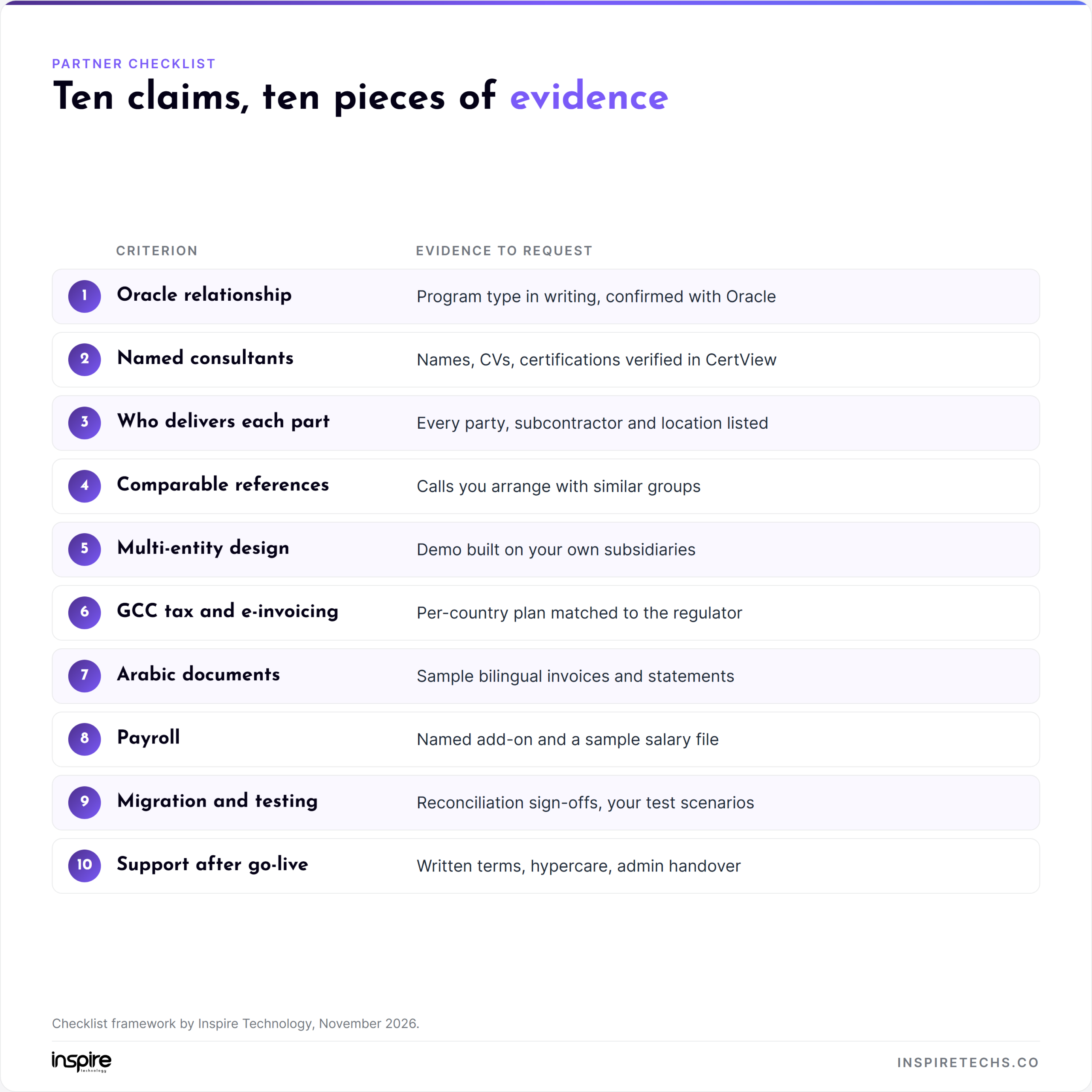
Rows 1 to 4 test the partner itself. Rows 5 to 10 test the plan for your business, and each one has its own section below.
How do you verify a partner’s status and its consultants’ certifications?
You verify a partner’s status with Oracle, and you verify a consultant’s certification through Oracle CertView with that consultant’s involvement. Partner status belongs to the firm. Certifications belong to individual people, so check the two facts separately.
- Ask each partner to state in writing its NetSuite partner program type and the countries it is set up to serve.
- Send that statement to the Oracle NetSuite contact handling your subscription discussion and ask them to confirm it.
- Ask for the names of the consultants proposed for your project, with CVs and the Oracle certifications each one holds.
- Ask each named consultant to publish the certification to you. Oracle states that it cannot verify certification status to third parties without the candidate’s direct involvement. The consultant starts the request in Oracle CertView, and you receive a time-limited link and a separate password.
- Record each result in your scoring sheet against the person, and write the verified people into the proposal’s team schedule.
Write the verified consultants into the contract as named team members. Ask what happens to your project plan if one of them leaves the firm.
Who will actually deliver your NetSuite project?
Your NetSuite project is delivered by whoever the proposal names, so ask for a table that lists every party and what each one does. A partner may bring in a subcontractor for specialist work, such as an e-invoicing connector, payroll, or a country it does not staff itself. A subcontractor is acceptable when the proposal names it and you approve it before signing.
| Workstream | Question to ask | A clear answer contains |
|---|---|---|
| Project management | Who runs the plan and chairs the steering meetings? | A named lead, their location and the meeting rhythm |
| Finance configuration | Who designs the chart of accounts, subsidiaries and approvals? | Named functional consultants and their certifications |
| Integrations | Who builds and supports each connection to your banks, CRM and other systems? | Each integration listed with its builder and its support owner |
| E-invoicing | Who connects NetSuite to each country’s e-invoicing model? | The connector or service provider by country, and who supports it after a rule change |
| Payroll | Which product produces salary files, and who sets it up? | A named add-on or HR system and the firm responsible |
| Onsite work | Which workshops, tests and go-live days happen onsite, and in which countries? | A list of onsite activities by country, with the people attending |
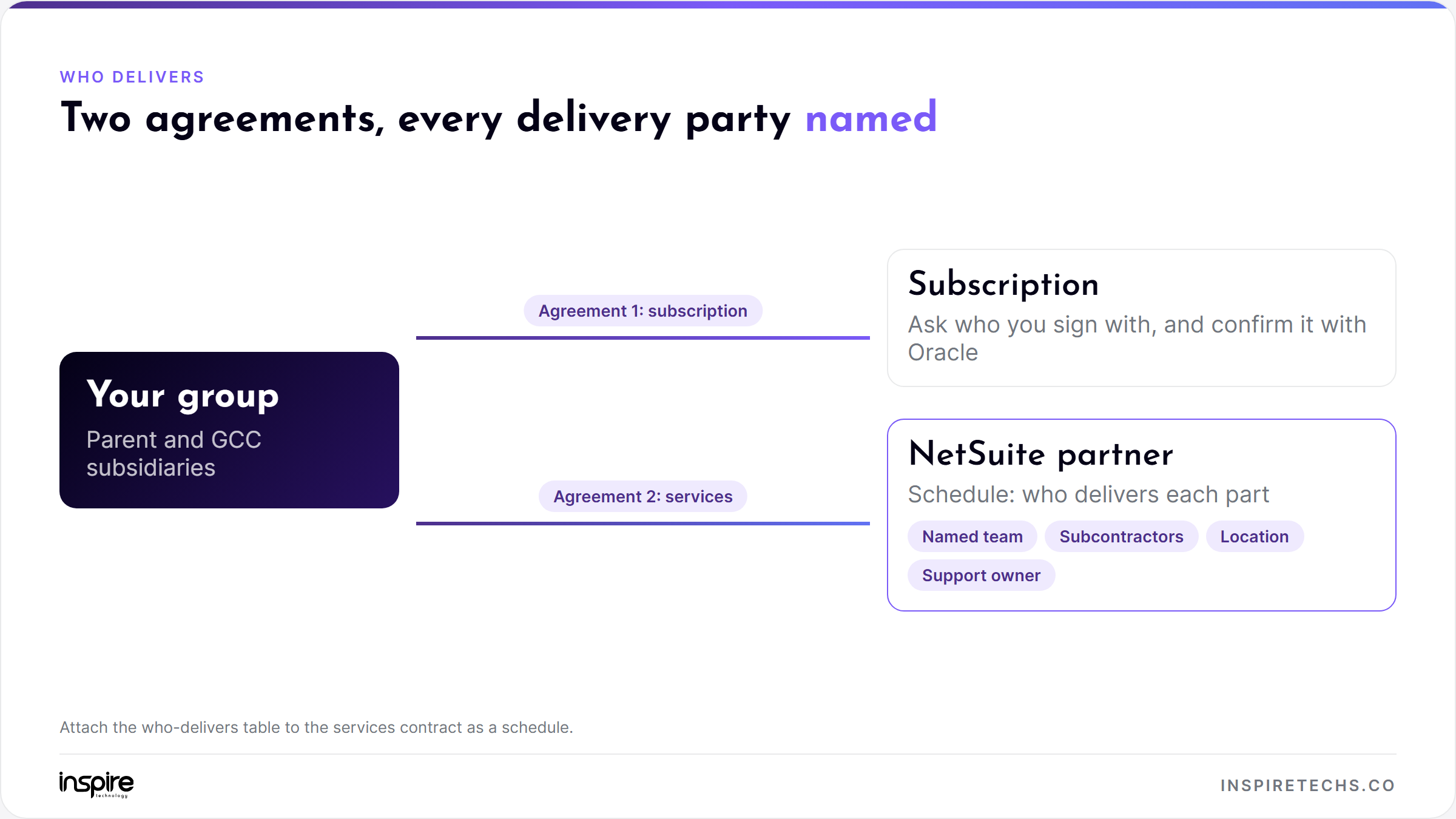
A NetSuite project involves two agreements: the subscription and the services contract. Ask each partner to state who you sign each one with, and confirm the answer with Oracle before you compare proposals.
Also Read: ERP Implementation Guide: Phases, Costs and Common Challenges
How do you test a partner’s implementation track record?
You test a partner’s implementation track record by speaking to customers whose projects resemble yours. Size, industry, entity count and countries matter more than the total number of projects a partner quotes. Ask for two or three references and call them without the partner on the line.
- What was in scope at go-live, and what moved to a later phase?
- Which of the partner’s people worked on your project, and are they still with the firm?
- How did the partner handle a change request or a missed date?
- How were VAT reporting and e-invoicing set up for your countries, and who supports them now?
- What does support look like six months after go-live?
Weigh evidence by how easily you can check it. A reference call you arrange yourself is strong evidence. Logos on a slide, unnamed testimonials and award badges are weak evidence, because you cannot test them against your own project.
What GCC requirements should a NetSuite partner explain clearly?
A NetSuite partner should explain how your group will meet tax, e-invoicing, language, payroll and data-location requirements in each country you operate in. Some of these sit inside NetSuite, and others need an add-on, an integration or a separate service provider. The table lists the published rule or product fact and the question to put to each partner.
| Requirement | What the primary source says | Question for the partner |
|---|---|---|
| UAE e-invoicing | The UAE Ministry of Finance e-invoicing model reports invoice tax data to the Federal Tax Authority through UAE Accredited Service Providers, under Ministerial Decisions No. 243 and 244 of 2025 | Which Accredited Service Provider will NetSuite connect to, and who builds and supports that connection? |
| Saudi e-invoicing | ZATCA’s Phase 2 (integration) has applied in waves since 1 January 2023, and ZATCA notifies taxpayers of their wave at least six months in advance | Has our Saudi entity been notified of a wave, and which integration approach will you use? |
| Omani e-invoicing | The Oman Tax Authority is introducing e-invoicing in phases, from selected large taxpayers to all VAT-registered entities | How will the design let our Omani entity join when its phase starts? |
| Arabic | Oracle’s documentation doesn’t list Arabic as a system-supported UI language; Arabic appears in a separate website-translation list | How will you produce Arabic or bilingual invoices and statements, and what will Arabic-speaking users see? |
| Payroll | Oracle states that NetSuite OneWorld runs payroll only for U.S. subsidiaries | Which add-on or HR system will run our GCC payroll and produce Qatar Wage Protection System (WPS) salary files? |
| Group currencies | In OneWorld, each subsidiary can have its own base currency, and consolidated reports use a consolidated exchange rates table | How will you set base currencies and consolidation rates for our QAR, AED and SAR entities? |
| Data location | Oracle states that NetSuite accounts are hosted in various data centers worldwide and advises that integrations not be bound to a specific data center | Ask Oracle which data center will host your account, and ask the partner how your integrations follow Oracle’s advice |
Score a vague answer on any row as a weak answer. “We handle VAT” does not tell you who builds the e-invoicing connection or who maintains it after a rule change. Qatar-specific points, such as WPS files and Arabic documents for a Doha entity, are covered on the page for a NetSuite partner in Qatar.
What should the partner’s proposal include?
The partner’s proposal should include the scope by entity, the phases, the named team, who delivers each part and how changes are handled. Read it as a contract schedule, because a promise made in a meeting and missing from the proposal is outside the deal.
- Scope by entity and country: modules, processes, reports and integrations listed per subsidiary, so nothing is assumed for a second country.
- Phase plan: dated phases with a sign-off at the end of each, in the order a structured ERP implementation follows.
- Named team and who-delivers table: attached as schedules, with your right to approve replacements.
- Data migration: which records, how many years of history, who cleans the data and who signs off each reconciliation.
- Integrations: each system, the direction of data, and who builds and supports the link, including integration with your CRM.
- Testing and training: a test plan built on your scenarios, such as a month-end close and a group consolidation, plus training by role.
- Change control: how out-of-scope requests are raised, estimated and approved.
- Support and handover: the hypercare period, support terms, administrator access and configuration documentation that stay with you.
- Contract split: who you sign the NetSuite subscription with, and who you sign the services with.
Ask each partner which of your entities NetSuite suits least, and why. A wider look at ERP options in Qatar helps you test that advice.
Also Read: CRM and ERP Integration: Benefits, Challenges and Best Practices
How should you score and compare shortlisted partners?
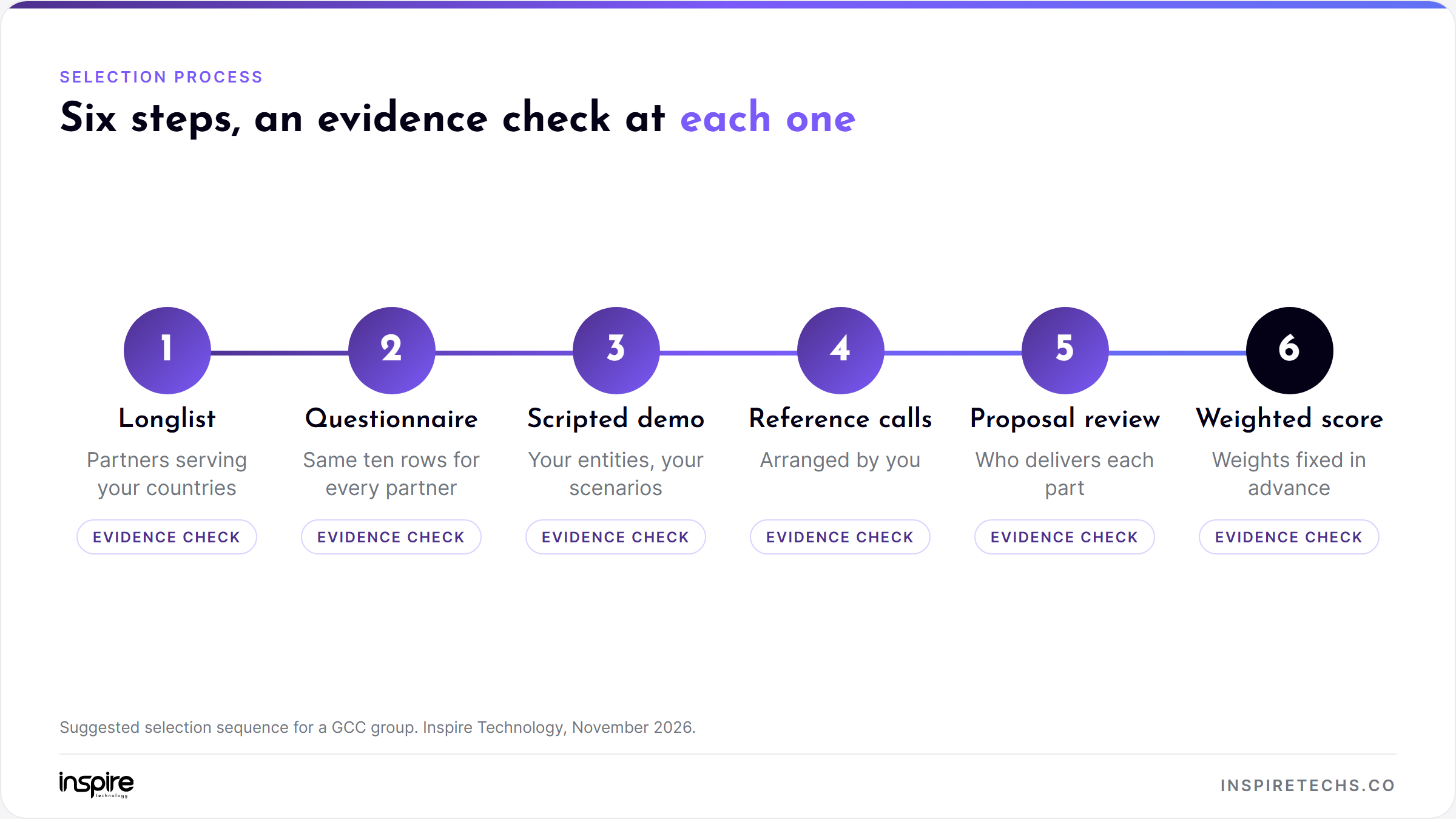
Score shortlisted partners with weights you agree before any demo, then rate each partner’s evidence from 0 to 5 on every criterion. Weights fixed in advance stop a polished demo from outweighing a weak delivery plan. The weights below are a starting point for a multi-entity GCC group, and you should adjust them to your own priorities.
| Criterion | Suggested weight | What earns a 5 |
|---|---|---|
| Oracle relationship | Pass or fail before scoring | Program type stated in writing and confirmed by Oracle |
| Who delivers each part | 15% | Every workstream named, with location and support owner |
| Named consultants | 15% | Named people with certifications verified through CertView |
| Comparable references | 15% | Two calls with customers of similar size and entity count |
| GCC tax and e-invoicing plan | 15% | A per-country plan that matches the regulators’ pages |
| Multi-entity design | 10% | A demo built on your own subsidiaries and currencies |
| Migration and testing | 10% | Reconciliation sign-offs and your scenarios in the test plan |
| Support after go-live | 10% | Written terms, hypercare and an admin access handover |
| Arabic documents | 5% | Sample bilingual documents shown in the demo |
| Payroll approach | 5% | A named product and a sample salary file |
Illustrative example: a Doha trading company
Illustrative example. Company X, a fictional 60-person trading and distribution W.L.L. in Doha, has two warehouses. It plans to add a UAE sales subsidiary and shortlists three NetSuite partners, labelled A, B and C here.
- Partner A gives the most polished demo but names no consultants and lists the UAE e-invoicing connection as “to be confirmed”. It scores 1 on who delivers and 1 on the GCC tax plan.
- Partner B names three consultants, two of whom publish their certifications through CertView, and lists a subcontractor for the UAE connection in its delivery table. It scores 4 on both rows.
- Partner C offers references of a similar size, but each reference ran a single-entity project. It scores 2 on comparable references.
Company X’s weighted totals put Partner B first, even though Partner A won the demo. The company and the scores are invented to show the method.
What are the warning signs during partner selection?
The main warning signs are answers you cannot verify and gaps the partner promises to fill later. Each one has a control you can write into the selection process or the contract.
| Warning sign | What goes wrong | Control |
|---|---|---|
| The proposal names the firm but no people | Unknown staff arrive after signing | A named team schedule and your right to approve replacements |
| A delivery partner appears after signing | Responsibility for defects becomes unclear | The who-delivers table as a contract schedule |
| References are logos or anonymous quotes | You cannot test fit with your project | Two reference calls you arrange yourself |
| E-invoicing is “phase two, to be scoped” | A UAE, Saudi or Omani entity misses its start date | A per-country plan dated against the regulator’s page |
| Arabic is “supported” with no sample | Invoices and statements fail customer expectations | Sample bilingual documents in the demo |
| Payroll is “covered” with no product named | Salary files are built late, close to go-live | A named add-on or integration and a sample file |
| Support ends at go-live | Your first month-end close runs without help | A hypercare period and support terms in the contract |
| Administrator access stays with the partner | A later change of partner is slow and costly | An admin access and documentation handover clause |
Inspire Technology’s approach to a first NetSuite conversation
Inspire Technology is an independent NetSuite Solution Provider Partner based in Doha. Our first two steps with a new enquiry are set out below, and you can score them with the same checklist:
- A free 30-minute consultation covers your entities, your current systems and the questions in this checklist.
- A written proposal follows and sets out the scope and who delivers each part, so you can score it against the same ten rows.
Our overview for a NetSuite partner for GCC groups explains multi-entity NetSuite and the questions the consultation covers.
Book a free consultation to run this checklist against your own entities and countries.
Frequently Asked Questions
What is a NetSuite partner?
A NetSuite partner is a firm in Oracle’s NetSuite partner program that works with customers on NetSuite projects, such as scoping, configuration, integration, data migration and support. Partners differ in program type, team size, the countries they serve and the experience of their named consultants. Ask each one to state its program type in writing, then confirm it with Oracle.
How many NetSuite partners should be on a shortlist?
Inspire Technology suggests a shortlist of three partners. Three sets of answers give you enough to compare on every criterion. The reference calls and scripted demos also stay manageable for your finance and IT leads. Start with a longer list, send the ten questions in writing, and invite the three strongest written responses to demo.
Can Oracle confirm a consultant’s NetSuite certification for me?
Oracle confirms a consultant’s certification only with the consultant’s direct involvement. The consultant signs in to Oracle CertView and publishes the credential to your email address. You then receive a unique link in one email and a password in another. Both are valid for a limited time, so check the credential as soon as they arrive.
Does NetSuite support Arabic?
NetSuite supports Arabic in a limited way: Oracle’s documentation doesn’t list Arabic as a system-supported UI language, and Arabic appears in a separate list of languages for website translation. Ask each partner to show sample bilingual invoices and statements in the demo. Ask them also to describe what Arabic-speaking users will see in daily work, such as approvals and reports.
Does a GCC group need a partner with staff in every country?
A GCC group needs a written delivery plan for every country. Ask which workstreams happen onsite, in which countries, and who delivers them. Then check the plan against each country’s rules, such as UAE e-invoicing through Accredited Service Providers and ZATCA’s integration waves in Saudi Arabia.