
Written by Inspire Technology Editorial Team. Updated November 2026.
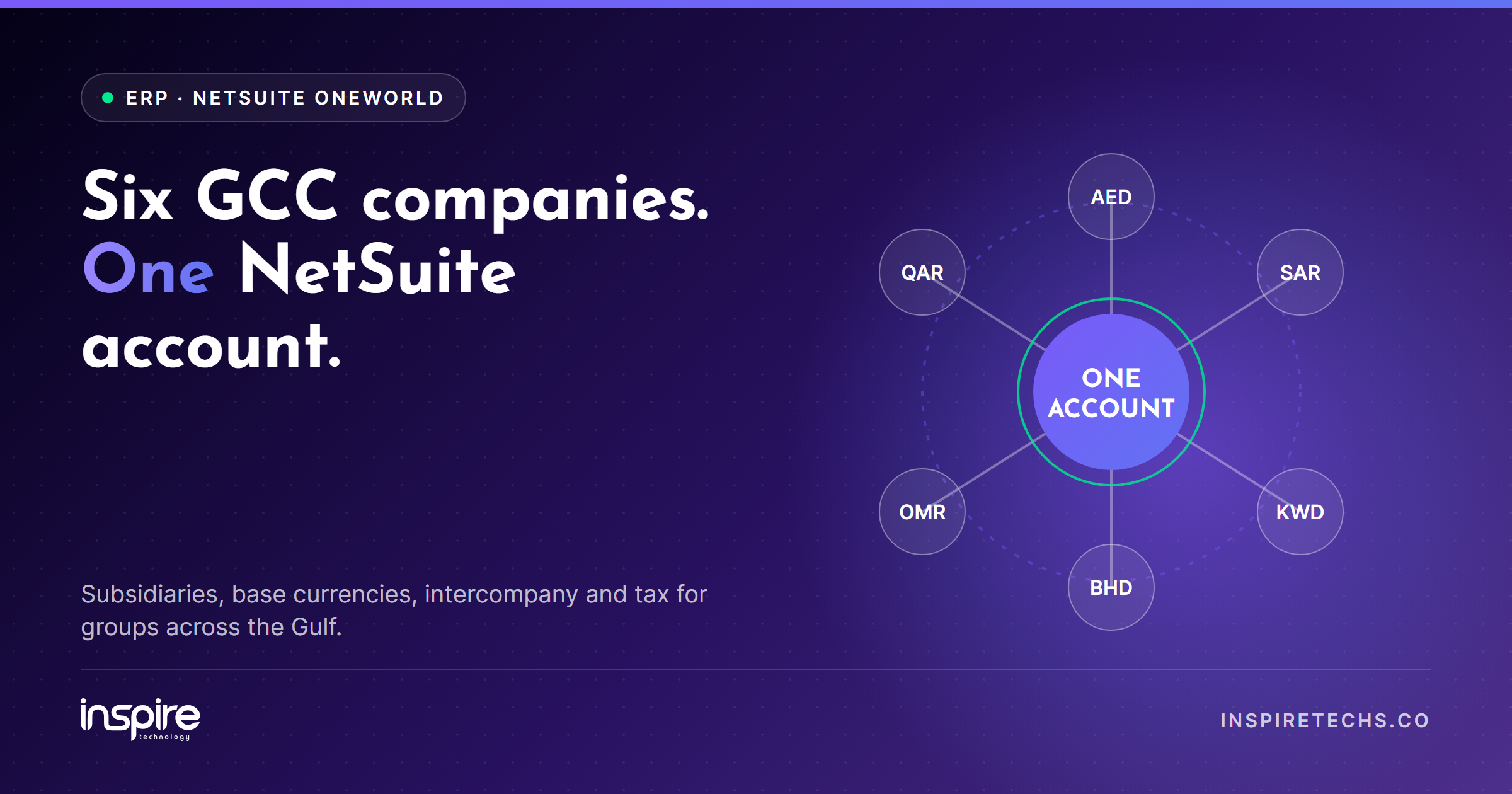
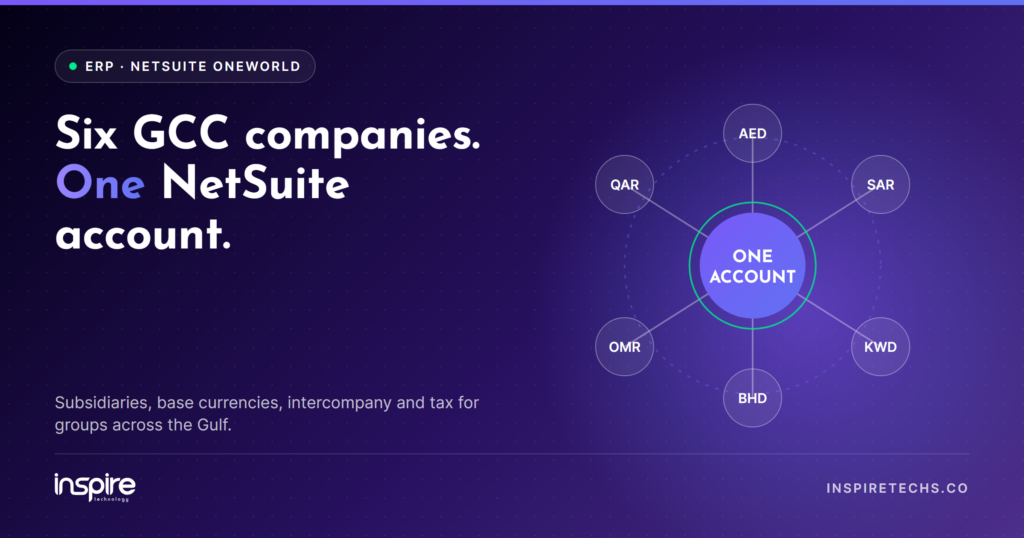
NetSuite OneWorld is the Oracle NetSuite edition that runs several legal entities in one account. Each GCC company becomes a subsidiary with its own base currency and tax nexus, and the group consolidates in the parent’s currency. Your hierarchy, intercompany flows and per-country tax setup decide the fit. This guide covers all three for Qatar, the UAE, Saudi Arabia, Kuwait, Bahrain and Oman.
Key Takeaways
- One subsidiary per legal entity: Oracle treats each OneWorld subsidiary as a separate legal entity for tax and regulation, with its own nexus and base currency.
- Some choices are permanent: a subsidiary’s base currency can’t be changed after the record is first saved, so the hierarchy is designed before setup.
- Eliminations run at period close: intercompany lines marked for elimination are reversed into an elimination subsidiary, so consolidated reports exclude trade between group companies.
- Tax support differs by country: Oracle’s GCC VAT setup topic has tax code tables for the UAE and Saudi Arabia. Bahrain and Oman use manually created tax codes, and Qatar and Kuwait have no VAT to configure.
What is NetSuite OneWorld?
NetSuite OneWorld is the NetSuite edition for organizations with more than one subsidiary. Oracle’s OneWorld overview describes it as organizing domestic and international subsidiaries into a single hierarchical structure. For a GCC group, that means one account holds the Doha parent, the Dubai trading company and the Riyadh company as separate entities.
Oracle’s documentation sets out four building blocks:
- Separate legal entities: each subsidiary is treated as a unique legal entity for taxation and regulation purposes.
- Nexus and base currency: each subsidiary has a tax jurisdiction and a base currency, and completes its transactions in that currency.
- Consolidated reports: data rolls up into the parent’s currency, with foreign currency translation for all child subsidiaries.
- Three reporting levels: each subsidiary’s own currency, its parent’s currency and the root parent’s currency.
Inspire Technology covers the wider platform, and how a GCC group assesses it, on its Oracle NetSuite page for GCC groups. This guide stays with the OneWorld mechanics.
How does OneWorld structure a group across GCC countries?
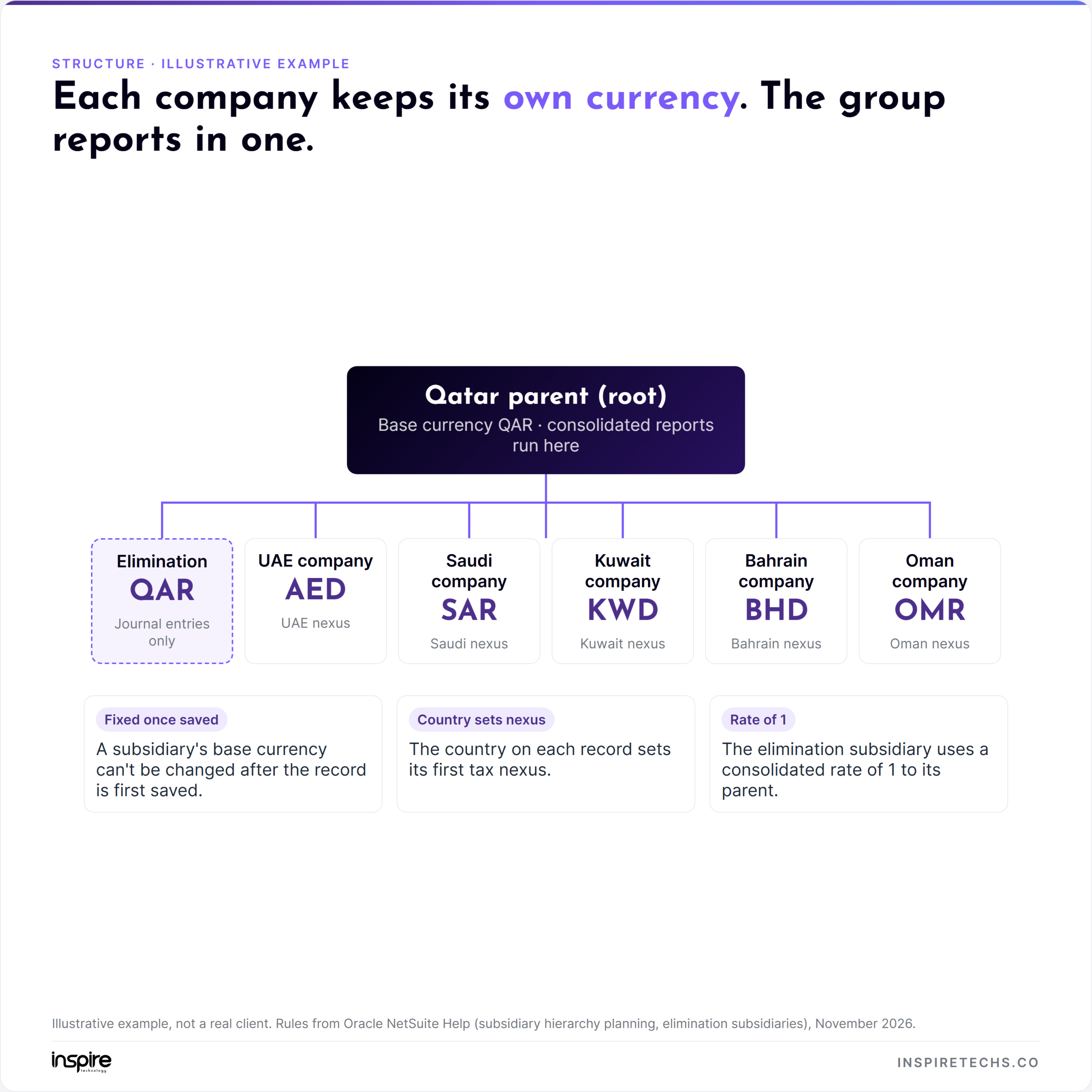
OneWorld structures a GCC group as a tree. The root parent sits at the top, each legal entity gets a subsidiary record below it, and each parent with children gets an elimination subsidiary. Oracle’s subsidiary hierarchy planning guidance sets the order of work:
- Diagram the tree first. Draw every parent-child relationship, starting with the root subsidiary.
- Add one elimination subsidiary per parent. It uses the same base currency and country as its direct parent.
- Set up taxes for each nexus. Oracle advises creating nexuses and their taxes before the subsidiary records.
- Create records top-down. The country on each record sets its first tax nexus, and the base currency is fixed once saved.
Oracle allows the hierarchy to be modified later, and warns that a modification may damage your data and reporting. A group that plans to open in Oman next year should draw that subsidiary into the tree now.
What changes when a GCC group moves to one OneWorld account?
A move to one OneWorld account changes where consolidation happens. Group reporting moves from spreadsheets assembled after each close into reports run inside the account. The table compares the two set-ups on the points a group finance team checks first.
| Point | Separate accounting system per country | One NetSuite OneWorld account |
|---|---|---|
| Ledgers | One database per company | One subsidiary per company, each with its own books in the same account |
| Currency | Each system set to its local currency | Each subsidiary has its own base currency; reports also run in the parent’s currency |
| Group reporting | Trial balances exported and combined after close | Consolidated reports for a parent and its children, translated with the consolidated exchange rates table |
| Intercompany | Both sides entered separately and matched by hand | Intercompany transactions and journals, with elimination journal entries at period close |
| Master data | Customers, vendors and items kept per system | Customers, vendors, employees and items associated with one or more subsidiaries |
| Adding a country | A new system or database | A new subsidiary record with its own nexus and base currency |
Also Read: ERP Implementation Guide: Phases, Costs and Common Challenges
How does OneWorld handle base currencies and exchange rates?
OneWorld handles currencies at two levels. Each subsidiary keeps its books in its own base currency, and a separate consolidated exchange rates table translates those books into the parent’s currency. Oracle defines three consolidated exchange rate types:
| Rate type | What it is | Default accounts |
|---|---|---|
| Current | The rate in effect at the end of the period | Balance sheet accounts other than equity |
| Average | The weighted average of rates for transactions in the period | Income statement accounts |
| Historical | Calculated like Average, for accounts set to Historical | Equity accounts |
Oracle advises updating consolidated exchange rates at the end of each accounting period, as part of period close. Transaction exchange rates can be updated manually or automatically. Four GCC details shape the currency design:
- The Kuwaiti dinar moves against the group. The Central Bank of Kuwait has pegged the dinar to an undisclosed basket of currencies since May 2007, so a KWD subsidiary’s rate to a QAR or SAR parent moves each period.
- Fils and baisa need a decision. The Kuwaiti dinar is divided into 1,000 fils, and Bahraini and Omani amounts are also stated in fils and baisa. How these amounts are held in your account is confirmed during scoping.
- Saudi VAT stays in riyals. ZATCA requires the VAT amount on a tax invoice in Saudi riyals, whatever the invoice currency (as of November 2026).
- Bahrain VAT stays in dinars. The NBR requires VAT shown in Bahraini dinars, converted at the Central Bank of Bahrain approved rate (as of November 2026).
How do intercompany transactions and eliminations work?
Intercompany activity is recorded with intercompany transactions and journals, and an elimination run reverses it at period close. Oracle’s Automated Intercompany Management feature generates the elimination journal entries. The mechanics, from Oracle’s intercompany elimination overview:
- Intercompany purchase and sales orders let one subsidiary buy from another, so each side posts in its own books.
- Intercompany inventory transfers move stock between subsidiaries, for example from a UAE warehouse to a Qatar company.
- Advanced intercompany journal entries handle shared-service recharges, with multiple receiving subsidiaries and any currency set up in the account.
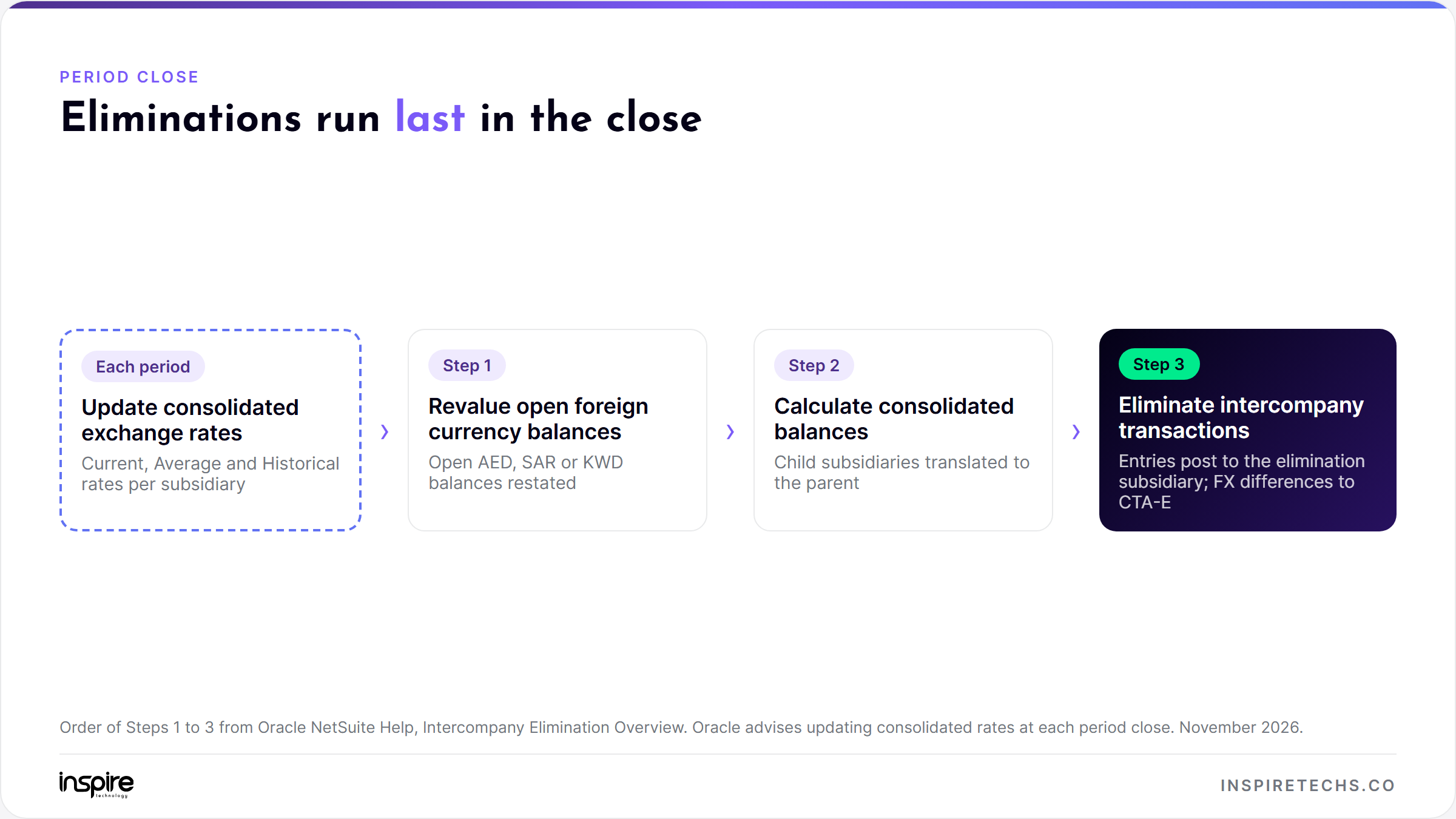
- Elimination journal entries post only to the elimination subsidiary, for lines with the Elimination box checked. Exchange differences post to the Cumulative Translation Adjustment-Elimination (CTA-E) account.
Oracle states that without the feature, you create, track and post all eliminations by hand. The period close order is fixed, as the figure shows.
Illustrative example: Company X, a fictional trading W.L.L., runs a Doha parent in QAR and a UAE warehouse subsidiary in AED. The UAE company transfers stock to Doha on an intercompany transfer, and each side posts in its own currency. At month end, finance updates consolidated rates, revalues open AED balances, calculates consolidated balances, then runs elimination so the group accounts show only sales to outside customers.
UAE groups have one dated exception to plan for. Ministerial Decision 197 of 2026 excludes transactions between members of the same UAE VAT Tax Group from e-invoicing for 24 months from 1 January 2027 (as of November 2026). Group companies outside that Tax Group are not covered.
How is tax set up for each GCC country in OneWorld?
Tax in OneWorld is set per subsidiary. Each company gets a nexus from its country, and the tax codes, reports and SuiteApps Oracle documents differ from country to country. The table sets out the position as of November 2026.
| Country | Base currency | VAT (as of November 2026) | What Oracle documents for NetSuite |
|---|---|---|---|
| Qatar | QAR | No VAT | Not on the SuiteTax rate update list; standard tax codes and reports |
| UAE | AED | 5% | UAE VAT Report (split by emirate) in the International Tax Reports SuiteApp; UAE Electronic Invoicing SuiteApp, which requires OneWorld |
| Saudi Arabia | SAR | 15% | Saudi tax codes in the International Tax Reports SuiteApp; Saudi Arabia E-Invoicing SuiteApp with Arabic invoice fields |
| Kuwait | KWD | No VAT | Not on the SuiteTax rate update list; no Kuwait VAT report listed |
| Bahrain | BHD | 10% | Tax codes created manually; Sales and Purchase by Tax Code reports; monthly SuiteTax rate updates |
| Oman | OMR | 5% | Tax codes created manually; monthly SuiteTax rate updates |
Country notes for scoping each subsidiary are on Inspire Technology’s pages for NetSuite in the UAE, NetSuite in Saudi Arabia, NetSuite in Kuwait, NetSuite in Bahrain and NetSuite in Oman.
The tax engine is the decision to settle before subsidiaries are built. Oracle documents some GCC features for Legacy tax accounts and others for SuiteTax accounts:
- Saudi tax codes from the International Tax Reports SuiteApp sit under Legacy tax and are documented as incompatible with SuiteTax.
- The Saudi E-Invoicing SuiteApp works in accounts with or without SuiteTax.
- SuiteTax monthly rate updates cover Bahrain, Oman, Saudi Arabia and the UAE, according to Oracle’s tax rate update list.
Qatar-specific detail, including corporate tax and the draft e-invoicing law, is on Inspire Technology’s NetSuite page for Qatar companies.
What GCC rules should a multi-country group plan for?
A multi-country group should plan for e-invoicing deadlines, Arabic invoice rules, payroll outside NetSuite and top-up tax data. E-invoicing arrives country by country, so each subsidiary meets its own date, as the timeline shows.
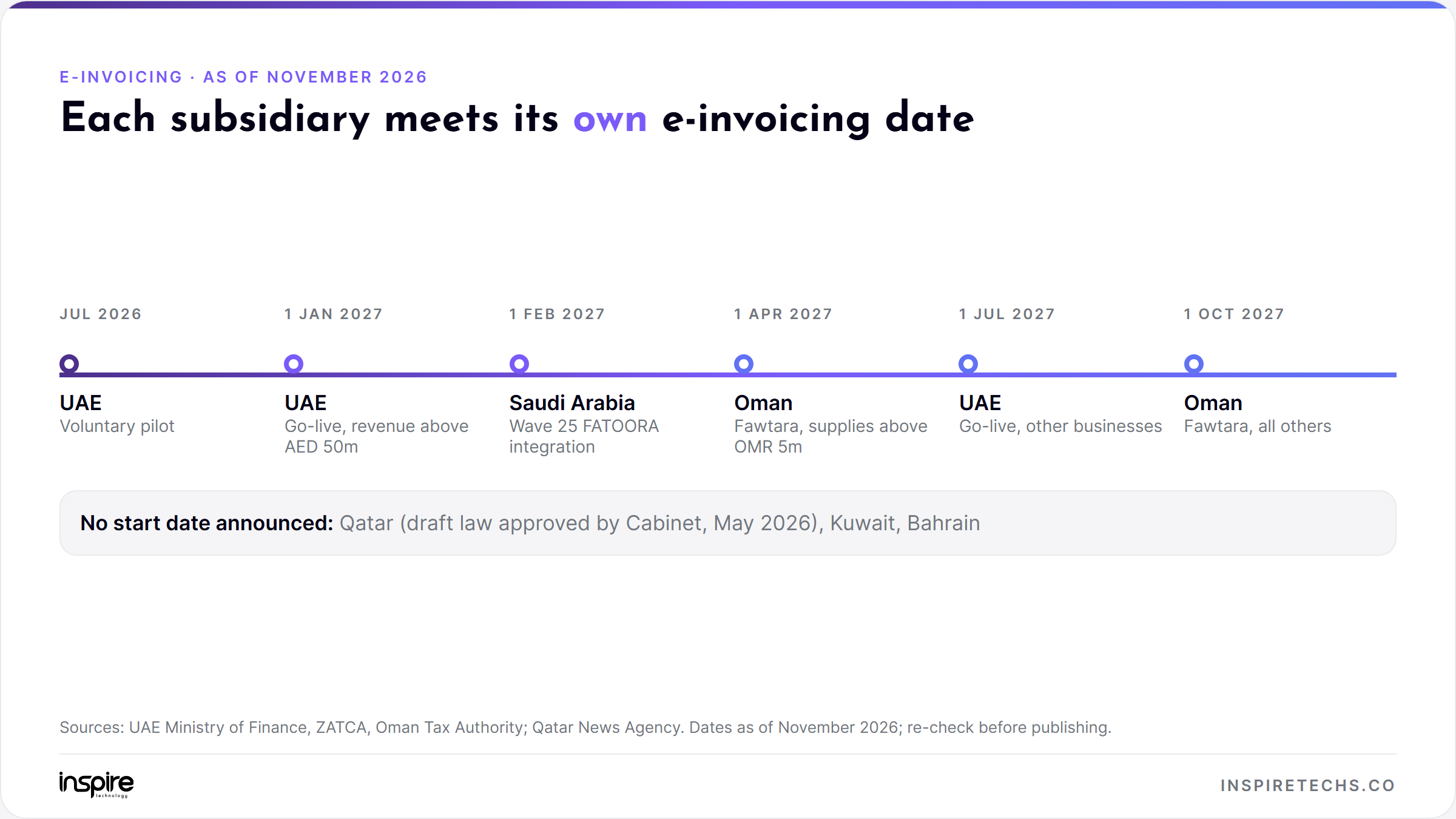
- UAE: as of November 2026, a voluntary pilot has run since 1 July 2026, and businesses with revenue above AED 50 million go live on 1 January 2027. Others appoint an Accredited Service Provider by 31 March 2027 and go live on 1 July 2027 (UAE Ministry of Finance).
- Saudi Arabia: as of November 2026, Wave 25 covers taxpayers with VAT-subject revenue above SAR 187,500 in any year from 2022 to 2025, who integrate with FATOORA by 1 February 2027 (ZATCA).
- Oman: as of November 2026, Fawtara applies from 1 April 2027 to taxpayers with supplies above OMR 5 million and from 1 October 2027 to others (Oman Tax Authority).
- Qatar, Kuwait and Bahrain: as of November 2026, none has a start date for e-invoicing. Qatar’s Cabinet approved a draft law in May 2026.
- Arabic invoices: as of November 2026, ZATCA requires tax invoice fields in Arabic. Oracle’s documentation doesn’t list Arabic as a system-supported interface language, and Arabic invoice templates render right to left.
- Payroll: SuitePeople U.S. Payroll runs only for U.S. subsidiaries. GCC salaries run in a payroll add-on or HR system that posts journals to the right subsidiary.
- Top-up tax: as of November 2026, the UAE (from 2025) and Saudi Arabia (from 1 January 2027) apply a domestic minimum top-up tax to groups with consolidated revenue of EUR 750 million or more. The calculation needs entity-level figures.
Also Read: CRM and ERP Integration: Benefits, Challenges and Best Practices
Where do OneWorld rollouts go wrong for GCC groups?
OneWorld rollouts go wrong on setup decisions that are hard to reverse. Each failure below has a control that belongs in the design phase.
| What goes wrong | Control |
|---|---|
| A subsidiary is saved with the wrong base currency, which can’t be changed | Sign off a currency per legal entity before any record is created |
| The hierarchy is reshuffled after go-live and past reports change | Draw the full tree, including planned countries, before setup |
| Consolidated rates go stale and group reports drift | Name an owner for the rate update on the period close checklist |
| Intercompany lines miss the Elimination flag and the group double counts | Define intercompany accounts in design and test a full close |
| The tax engine is chosen after nexuses exist | Check Oracle’s feature list for each country, then choose Legacy tax or SuiteTax |
| Arabic documents and fils or baisa amounts are assumed | Test Arabic templates and dinar and rial amounts during scoping |
Integrations between payroll, banking and NetSuite need their own controls. The guide to data integration across systems covers that layer.
Inspire Technology’s role in scoping OneWorld for GCC groups
Inspire Technology is an independent NetSuite Solution Provider Partner based in Doha. The work starts with the structure questions in this guide:
- A free 30-minute consultation reviews your group structure questions.
- A written proposal sets out the scope and who delivers each part.
Read more about Oracle NetSuite for multi-country GCC groups and the wider ERP options for Qatar companies.
Book a free consultation to walk through your group structure.
Frequently Asked Questions
Can a group add a new GCC subsidiary to an existing OneWorld account?
Yes. A group adds a new company as a new subsidiary record in the same account, with its own nexus, base currency and tax setup. The country on the record sets its first tax nexus. Oracle advises setting up the nexus taxes first and placing the subsidiary in the planned hierarchy, because its base currency is fixed once the record is saved.
Do partly owned companies and joint ventures fit into OneWorld?
Partly owned companies need more specialized accounting treatment than wholly owned subsidiaries. Oracle’s OneWorld overview states that the root parent owns 100% of all subsidiaries. It names affiliates, franchisees, joint ventures and similar shared-ownership entities as cases for that treatment. Groups with Saudi or Kuwaiti companies under mixed ownership should agree that treatment with their auditor before setup.
Can teams in the GCC use NetSuite in Arabic?
Teams use NetSuite in a supported language such as English, because Oracle’s documentation doesn’t list Arabic as a system-supported interface language (as of November 2026). Customer documents are a separate matter. Oracle documents Arabic printed invoices rendering right to left, and the Saudi Arabia E-Invoicing SuiteApp adds Arabic fields for customers, subsidiaries and items on invoice templates.
Who signs the NetSuite subscription for a GCC group?
A GCC group signs two separate agreements: the NetSuite subscription, which covers the OneWorld edition and any SuiteApps, and the services contract for the project. Ask each partner to state in writing who you sign each one with, and confirm the answer with Oracle before you compare proposals. This guide gives no subscription figures.
Does OneWorld need Automated Intercompany Management?
OneWorld runs without it, with more manual work at close. Oracle states that without the feature, you create and track intercompany transactions and post elimination journal entries by hand. With it enabled, NetSuite generates the elimination entries from lines marked for elimination as part of period close.