
ERP implementation plays a critical role in how businesses manage their financial operations, inventory, human resources, procurement, and daily workflows. An effective Enterprise Resource Planning (ERP) system connects these functions through a centralized platform. It helps organizations reduce operational silos, improve data accuracy, and make informed business decisions.
However, implementing ERP software requires more than installing a new application. Businesses must evaluate their existing processes, define project requirements, prepare data, configure the system, train employees, and manage the transition to new workflows.
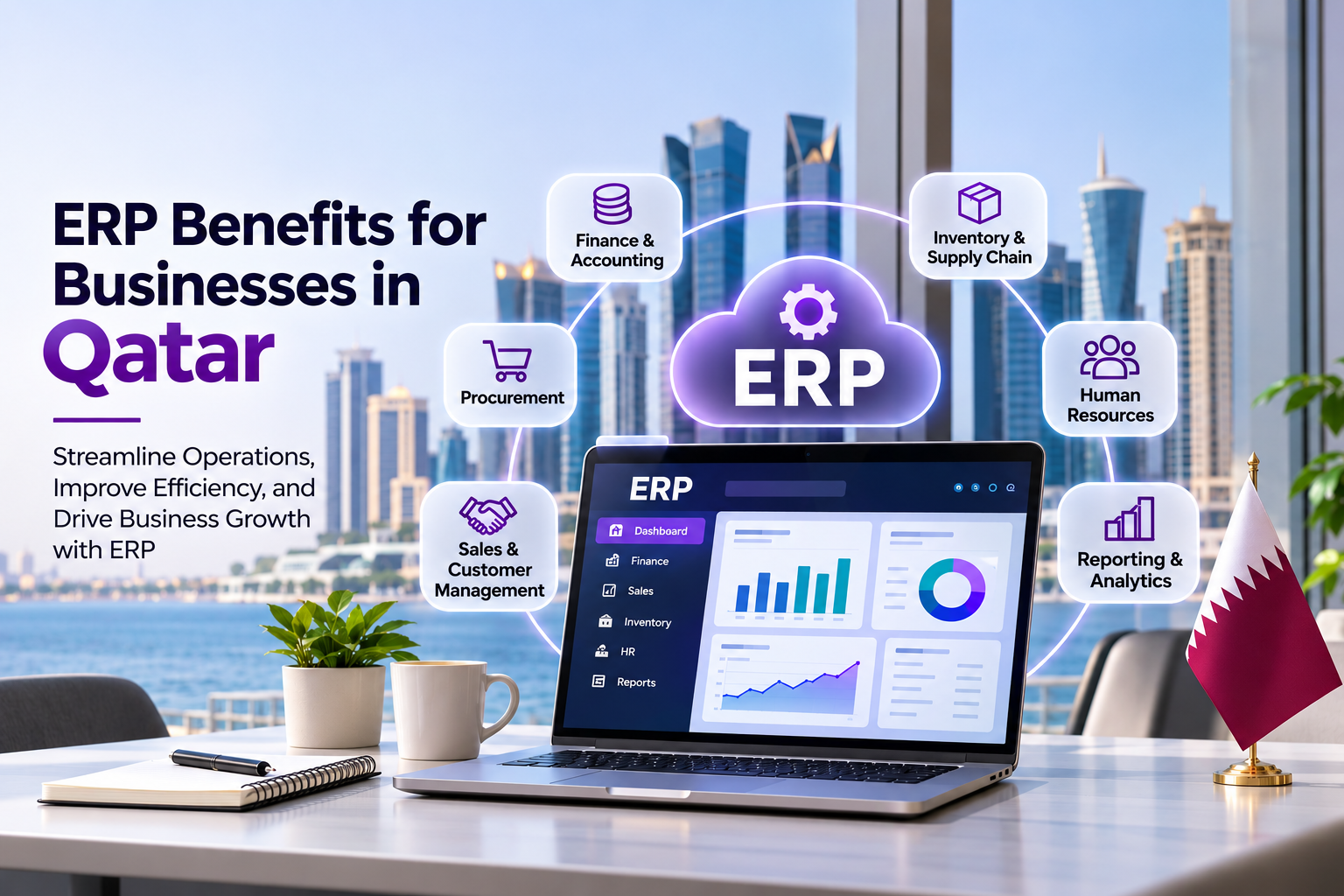
For businesses in Qatar, ERP implementation can support operational growth, multi-department coordination, financial visibility, and digital transformation. The right implementation strategy helps companies align technology with business objectives while controlling project risks.
This guide explains the ERP implementation process, its major phases, estimated costs, common challenges, and practical strategies for successful deployment.
What Is ERP Implementation?
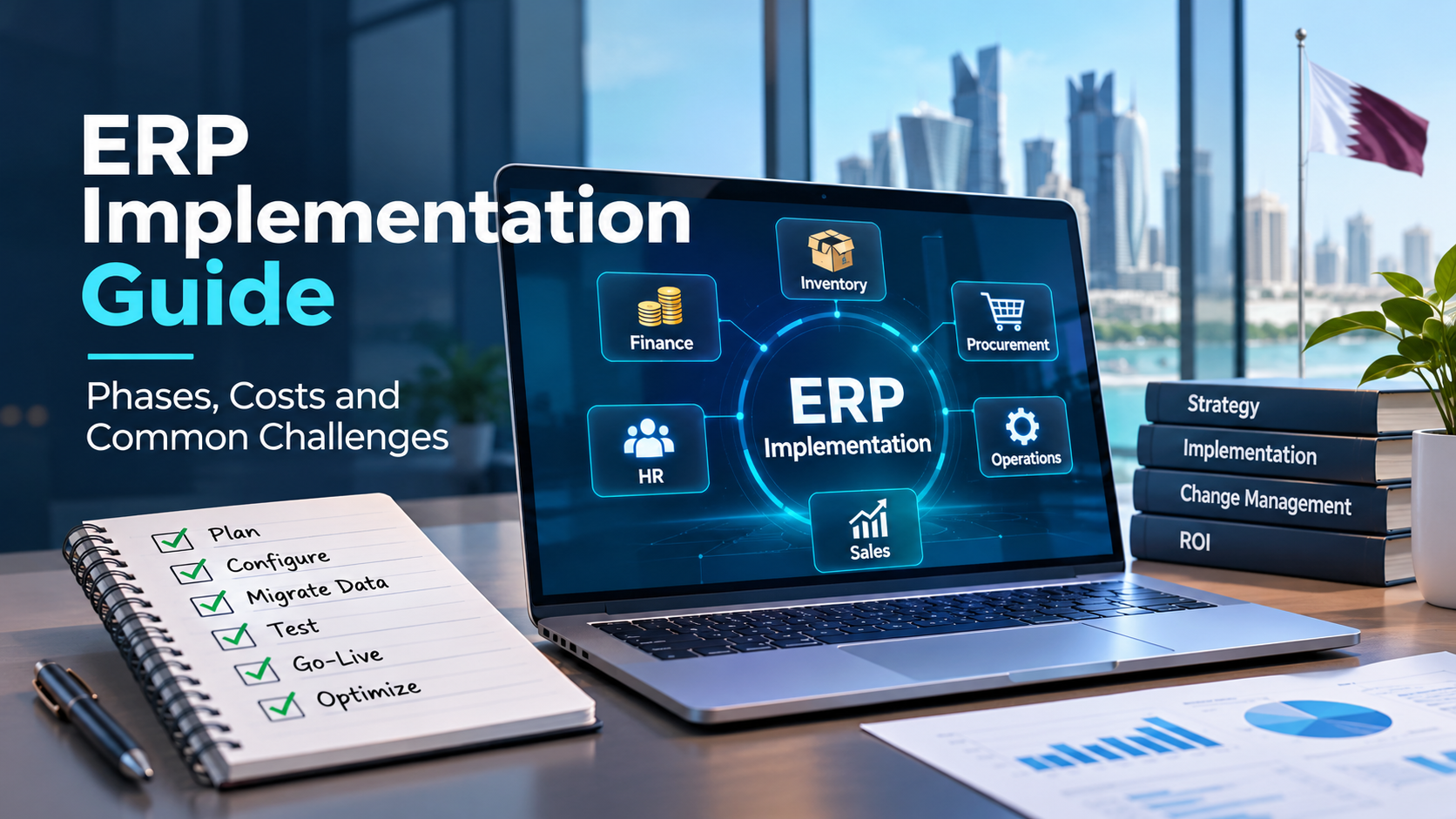
ERP implementation is the process of planning, configuring, deploying, and integrating an Enterprise Resource Planning system into an organization’s business operations.
The process connects different departments through shared software and standardized workflows. Instead of maintaining separate systems for finance, inventory, sales, procurement, and human resources, an ERP solution allows businesses to manage these functions within an integrated environment.
An ERP implementation project typically includes:
- Business requirements analysis
- ERP software selection
- Business process mapping
- System configuration and customization
- Data migration and validation
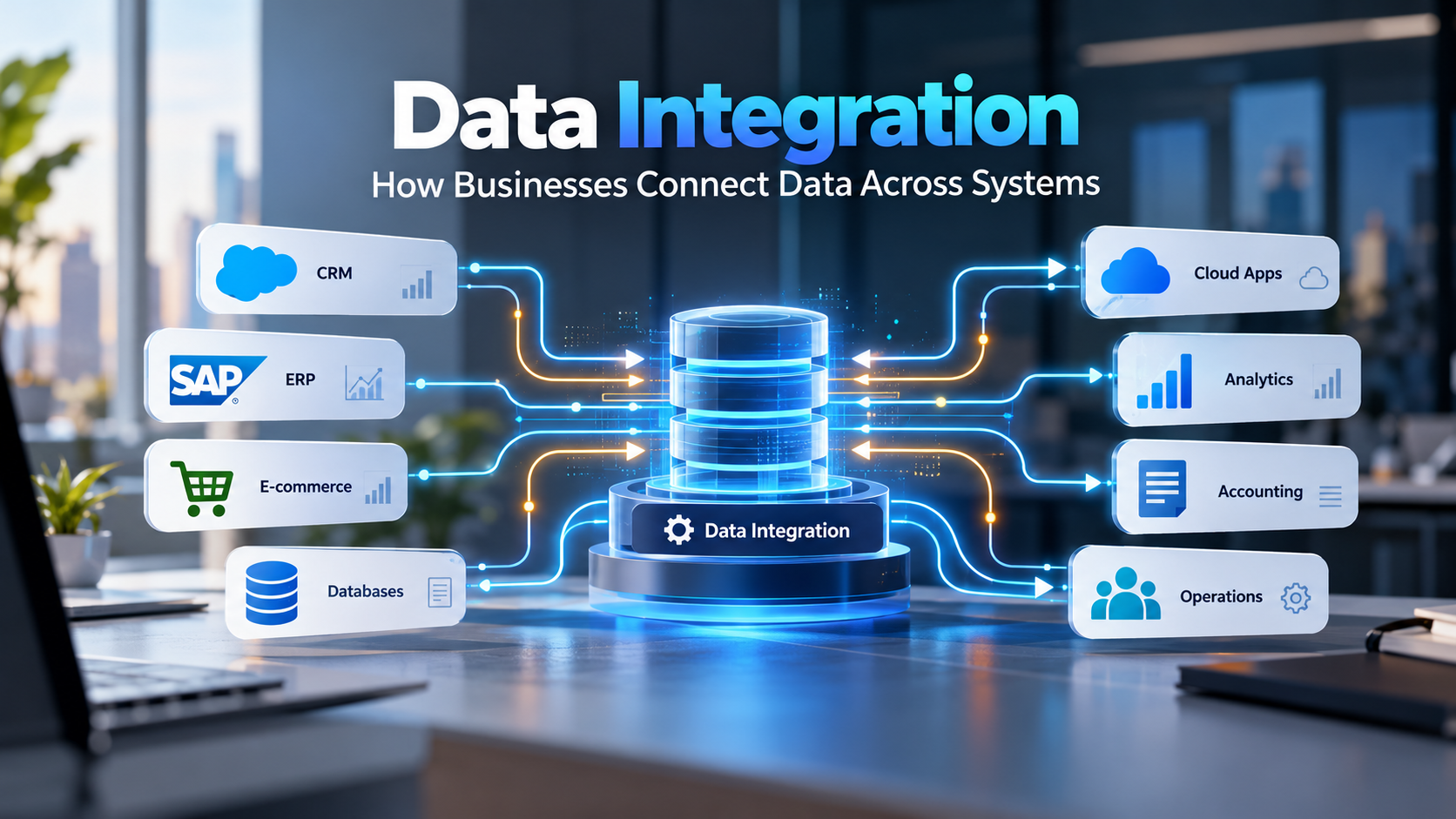
- Application integration
- Employee training
- Testing and deployment
- Post-implementation support
The primary objective of ERP implementation is to establish a reliable business management system that supports operational efficiency, reporting accuracy, and organizational growth.
How Does ERP Implementation Benefit Businesses?
A properly implemented ERP system can help businesses:
- Centralize business data across departments.
- Automate repetitive administrative processes.
- Improve financial reporting and visibility.
- Manage inventory and procurement more efficiently.
- Reduce manual data entry and inconsistencies.
- Improve collaboration between business functions.
- Support scalable operations as the organization grows.
ERP implementation benefits depend on the quality of business processes, software configuration, data management, and employee adoption.
What Are the Phases of ERP Implementation?
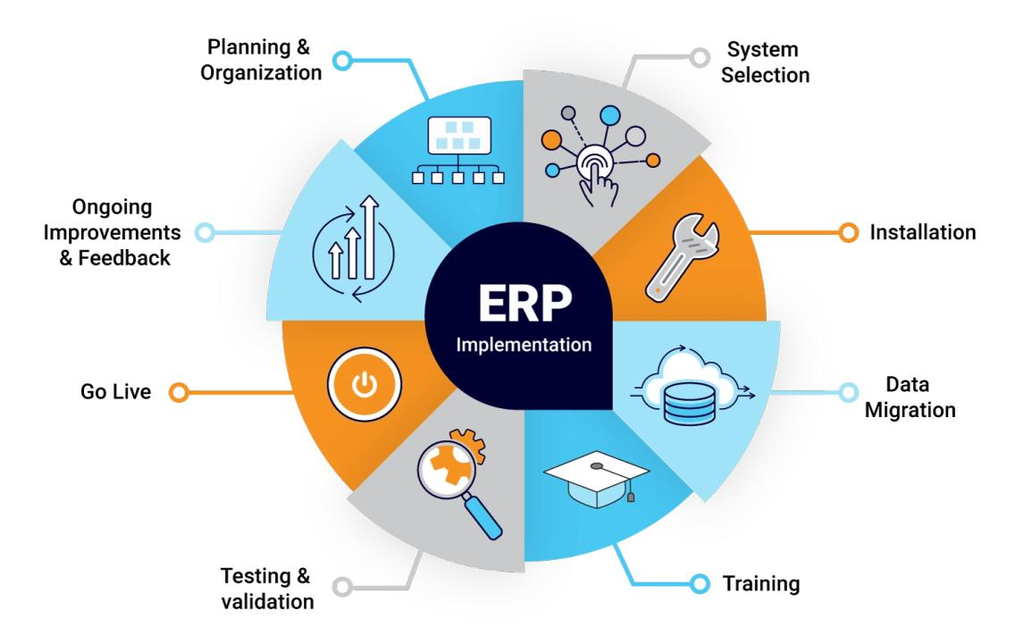
ERP implementation follows a structured project lifecycle. Although methodologies differ between ERP platforms and implementation partners, most projects include eight major phases.
The following lifecycle synthesizes implementation practices described by SAP, Oracle, and ERP implementation specialists.
1. Business Requirements Analysis and Planning
The planning phase establishes the foundation of the ERP project.
Businesses assess existing operations, identify process inefficiencies, and define the objectives of the new ERP system. The project team determines which departments, processes, and business entities will be included in the initial deployment.
Key activities include:
- Evaluating existing business processes.
- Identifying operational bottlenecks.
- Defining ERP project objectives.
- Establishing project scope and budget.
- Assigning project responsibilities.
- Creating an ERP implementation roadmap.
For example, a Qatar-based trading company may want to integrate finance, procurement, warehouse inventory, and sales operations into a single system.
A clearly defined scope helps prevent unnecessary features and uncontrolled project expansion.
2. ERP Software Selection
The next phase involves selecting an ERP platform that aligns with business requirements.
Organizations evaluate available ERP solutions based on functionality, scalability, deployment options, integration capabilities, licensing costs, and long-term support.
Common ERP evaluation criteria include:
| Evaluation Factor | Business Consideration |
| Functional Requirements | Finance, inventory, HR, procurement, and operations |
| Scalability | Ability to support business growth |
| Integration | Compatibility with existing applications |
| Deployment | Cloud ERP, on-premises, or hybrid |
| Customization | Ability to accommodate specialized workflows |
| Cost | Licensing, implementation, maintenance, and training |
| Support | Vendor and implementation partner expertise |
Companies should evaluate ERP platforms through demonstrations and documented requirements rather than relying solely on software features.
3. Business Process Mapping and System Design
ERP system design translates business requirements into system workflows.
The implementation team reviews current processes and develops future-state workflows. A fit-gap analysis identifies where standard ERP functionality meets requirements and where additional configuration, integration, or customization may be necessary.
Important activities include:
- Mapping existing and future business workflows.
- Defining user roles and access permissions.
- Designing approval hierarchies.
- Planning system integrations.
- Establishing reporting requirements.
- Documenting configuration decisions.
Businesses should prioritize standard ERP functionality whenever it meets their operational needs. Excessive customization can increase implementation costs and complicate future system upgrades.
4. ERP Configuration and Customization
During this phase, the ERP system is configured to support the approved business processes.
Configuration may include financial settings, inventory rules, approval workflows, user permissions, dashboards, reporting structures, and organizational hierarchies.
Customization involves modifying or extending the standard system to support requirements that cannot be met through configuration alone.
For example, a company may require a customized procurement approval workflow based on purchase value, department, or management authority.
The implementation team should document customizations and evaluate their long-term maintenance requirements before development begins.
5. ERP Data Migration
ERP data migration involves transferring business information from legacy systems, spreadsheets, databases, or existing ERP platforms into the new environment.
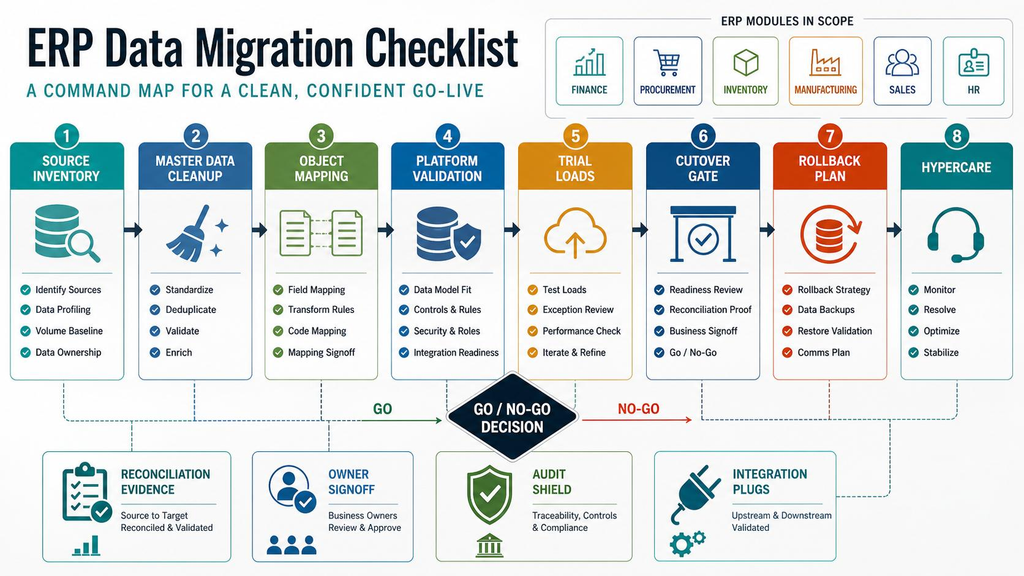
Data migration is a critical phase because inaccurate or incomplete information can affect reporting, inventory management, financial operations, and business decisions.
The ERP migration process generally includes:
- Data extraction from existing systems.
- Data cleansing and removal of duplicates.
- Data mapping to the new ERP structure.
- Data transformation into compatible formats.
- Trial migration and validation.
- Final data migration before go-live.
Businesses should validate customer records, supplier information, inventory balances, financial transactions, and opening balances before approving the final migration.
A controlled ERP migration reduces the risk of data inconsistencies and operational disruption.
6. ERP Testing and User Acceptance Testing (UAT)
ERP testing verifies whether the configured system meets business requirements.
The project team tests individual functions, integrations, workflows, reporting, security permissions, and end-to-end business transactions.
Common testing activities include:
- Unit testing
- Integration testing
- System testing
- User acceptance testing (UAT)
- Performance testing
- Security testing
User acceptance testing allows employees and business stakeholders to validate the ERP system against real business scenarios.
For example, the finance team may test invoice processing, payment approvals, financial reporting, and account reconciliation.
The implementation team should resolve critical defects before approving the production deployment.
7. ERP Deployment and Go-Live
ERP deployment marks the transition from the implementation environment to live business operations.
The organization activates the new ERP system according to its approved deployment strategy.
Common ERP deployment approaches include:
| Deployment Strategy | Description | Best Suited For |
| Big Bang | All selected departments switch at once | Smaller organizations with manageable complexity |
| Phased Rollout | Departments or modules launch in stages | Organizations seeking controlled transitions |
| Pilot Deployment | A limited business unit launches first | Companies that want to validate the system |
| Parallel Deployment | Legacy and new systems operate simultaneously | Higher-risk transitions requiring comparison |
The implementation team should prepare a cutover plan, confirm data readiness, communicate the launch schedule, and establish support procedures.
The go-live period often includes hypercare, an intensive support phase that helps employees resolve initial system issues.
8. Post-Implementation Support and Optimization
ERP implementation does not end at go-live.
Businesses must monitor system performance, review user adoption, resolve issues, and identify opportunities for improvement.
Post-implementation activities include:
- Monitoring ERP system performance.
- Resolving operational issues.
- Reviewing user feedback.
- Improving reports and dashboards.
- Optimizing workflows.
- Managing software updates.
- Evaluating business performance against project objectives.
Continuous optimization allows organizations to improve ERP utilization and adapt the system to changing business requirements.
How Much Does ERP Implementation Cost?
ERP implementation costs vary based on business size, software selection, project complexity, deployment model, customization, and the number of departments involved.
There is no universal ERP implementation price. A small business with standard workflows may require a significantly smaller investment than a large enterprise with multiple business entities, complex integrations, and extensive customization.
Key Factors That Affect ERP Implementation Costs
| Cost Factor | How It Affects the Budget |
| ERP Software Licensing | Subscription fees, user licenses, or software purchase costs |
| Business Size | Larger organizations typically require broader functionality |
| Implementation Scope | More departments and modules increase project effort |
| Customization | Custom development adds design, testing, and maintenance costs |
| Data Migration | Legacy data cleansing, transformation, and validation require resources |
| System Integration | Connecting ERP with CRM, e-commerce, HR, and other applications |
| Employee Training | Training sessions, documentation, and change management |
| Infrastructure | Hosting, cloud services, servers, and security requirements |
| Support and Maintenance | Ongoing technical support, updates, and system optimization |
ERP Implementation Cost Breakdown
An ERP project budget should account for both initial implementation expenses and recurring operational costs.
| Cost Category | What It Includes |
| Software Licensing | ERP subscriptions or license fees |
| Consulting | Requirements analysis and implementation planning |
| Configuration | System setup and workflow design |
| Custom Development | Extensions and specialized functionality |
| Data Migration | Data cleansing, mapping, and transfer |
| Integration | API development and third-party system connections |
| Training | Employee onboarding and user education |
| Testing | Validation, defect resolution, and UAT |
| Support | Hypercare, maintenance, and ongoing assistance |
Businesses should request a detailed cost estimate that separates one-time implementation costs from recurring software and support expenses.
A realistic ERP budget should also include contingency funding for unexpected technical requirements, data quality issues, or changes in project scope.
How to Estimate ERP Implementation Costs
Organizations can create an initial ERP implementation budget through a structured estimation process:
- Define the business requirements and implementation scope.
- Identify the ERP modules and user licenses required.
- Evaluate the existing infrastructure and applications.
- Estimate configuration, customization, and integration effort.
- Calculate data migration and employee training costs.
- Include ongoing support and maintenance expenses.
- Review the budget with the implementation partner.
ERP implementation estimates should be based on a documented project scope. Vendor-specific pricing and local implementation costs require a tailored assessment.
What Is the ERP Implementation Timeline?
The ERP implementation timeline depends on organizational complexity, software selection, data readiness, integrations, customization, and the availability of internal project resources.
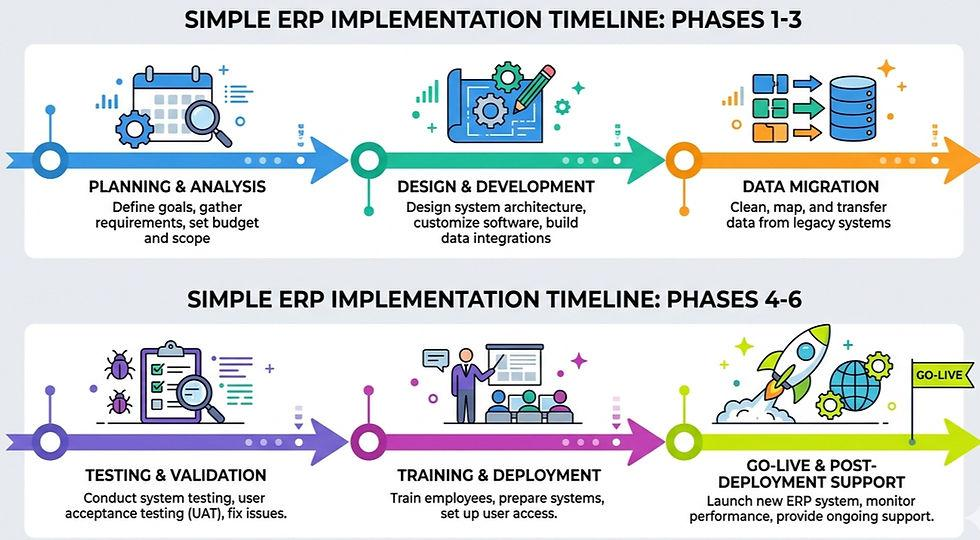
As a general planning reference, implementation projects may take several months for smaller organizations and considerably longer for complex enterprise deployments. ERP Research describes mid-market implementations as commonly taking 6–18 months, while Rand Group provides broader implementation ranges depending on project scope.
A practical project timeline should include:
| Project Phase | Timeline Consideration |
| Planning and Requirements | Business objectives, scope, and stakeholder alignment |
| ERP Selection | Evaluation, demonstrations, and vendor selection |
| System Design | Process mapping and fit-gap analysis |
| Configuration and Development | System setup and approved customization |
| Data Migration | Data cleansing, mapping, and trial migration |
| Testing and Training | UAT, employee training, and defect resolution |
| Go-Live | Production deployment and cutover |
| Hypercare | Post-launch support and stabilization |
Several activities can run in parallel. For example, data preparation and employee training may begin while the ERP system is being configured.
The organization should establish milestone-based timelines rather than relying on a generic ERP implementation duration.
What Are the Common ERP Implementation Challenges?
ERP projects involve technical, operational, and organizational changes. Poor planning or weak project governance can lead to delays, budget overruns, and low employee adoption.
1. Unclear Business Requirements
Unclear requirements create confusion during system design and configuration.
The project team may develop unnecessary features or overlook essential business workflows.
Solution: Conduct detailed requirements workshops and obtain stakeholder approval before implementation begins.
2. Poor Data Quality
Legacy systems may contain duplicate records, outdated information, inconsistent formats, or incomplete transaction histories.
These problems can affect ERP migration and reporting accuracy.
Solution: Perform data profiling, cleansing, mapping, and validation before the final migration.
3. Excessive Customization
Extensive customization increases project complexity, development effort, testing requirements, and long-term maintenance.
Solution: Prioritize standard ERP functionality and use customization only when a documented business requirement justifies it.
4. Employee Resistance to Change
Employees may struggle to adopt new workflows or prefer existing systems.
Poor communication can reduce ERP adoption and operational effectiveness.
Solution: Introduce change management, role-based training, employee communication, and departmental support.
5. Budget Overruns
Unexpected integrations, data migration issues, scope changes, and additional development can increase ERP implementation costs.
Solution: Establish a realistic budget, maintain scope control, and monitor project expenses throughout implementation.
6. Inadequate Testing
Insufficient testing can allow workflow errors, integration failures, and reporting problems to reach production.
Solution: Establish testing criteria, conduct end-to-end validation, and require UAT sign-off before go-live.
7. Weak Project Governance
ERP implementation involves multiple departments, technical teams, business stakeholders, and decision-makers.
Delayed decisions can affect project milestones.
Solution: Assign a project owner, establish a steering committee, define responsibilities, and maintain a clear escalation process.
ERP implementation specialists consistently identify requirements, data readiness, change management, testing, and governance as major areas that influence project outcomes.
ERP Implementation Best Practices for Successful Deployment
Businesses can improve ERP implementation outcomes through a structured and business-focused approach.
Define Measurable Business Objectives
Establish clear goals before selecting or configuring the ERP system.
Examples include:
- Reduce manual financial reporting.
- Improve inventory visibility.
- Automate procurement approvals.
- Improve operational reporting.
- Reduce duplicate data entry.
Measurable objectives help organizations evaluate the effectiveness of the implementation.
Establish a Dedicated ERP Project Team
ERP implementation requires collaboration between IT, finance, procurement, operations, HR, and management.
The project team should include business process owners, technical specialists, project managers, and executive sponsors.
Prioritize Data Readiness
Data migration should begin early in the implementation lifecycle.
Organizations should establish data ownership, cleansing procedures, validation rules, and migration responsibilities.
Adopt a Phased Implementation Strategy
A phased ERP deployment allows businesses to introduce functionality gradually.
For example, a company may implement finance and procurement first, followed by inventory management, HR, and advanced reporting.
The approach can reduce disruption and provide opportunities to resolve issues before subsequent modules launch.
Invest in Employee Training
Training should focus on actual business workflows rather than general system navigation.
Employees should understand how the ERP system supports their daily responsibilities.
Monitor ERP Performance After Go-Live
Organizations should track business KPIs after deployment.
Useful performance indicators include:
- Financial reporting turnaround time
- Inventory accuracy
- Procurement cycle time
- Order processing efficiency
- ERP user adoption
- System availability
A structured performance review helps identify improvement opportunities and supports long-term ERP value.
ERP Implementation for Businesses in Qatar
Businesses in Qatar operate across sectors such as trading, construction, retail, logistics, manufacturing, professional services, and hospitality.
As organizations expand, disconnected systems and manual processes can make business operations increasingly difficult to manage.
ERP implementation can help Qatar-based businesses centralize operational information, coordinate departments, improve financial visibility, and establish standardized workflows.
Organizations should evaluate ERP requirements according to their business structure, reporting needs, operational processes, and integration requirements.
For example:
- Trading companies may prioritize procurement, inventory, warehouse management, and financial reporting.
- Construction businesses may require project accounting, cost control, procurement, and resource management.
- Retail organizations may focus on sales, inventory, purchasing, and financial integration.
- Service companies may prioritize project management, billing, resource allocation, and customer management.
The ERP platform should align with the organization’s operational requirements rather than forcing every business to follow the same implementation model.
Choosing the Right ERP Implementation Partner
An experienced implementation partner can help businesses assess requirements, select suitable ERP functionality, configure workflows, manage data migration, and prepare employees for deployment.
Organizations should evaluate potential partners based on:
- ERP platform expertise.
- Business process understanding.
- Implementation methodology.
- Data migration capabilities.
- Integration experience.
- Project management approach.
- Training and support services.
- Clear project scope and cost estimates.
Inspire Technology provides ERP-related solutions for businesses in Qatar.
Businesses exploring implementation support can review Inspire Technology’s ERP implementation services to understand the available service offering.
They can also explore ERP solutions in Qatar for broader ERP-related capabilities.
Frequently Asked Questions About ERP Implementation
What is the ERP implementation process?
The ERP implementation process includes business requirements analysis, software selection, system design, configuration, data migration, testing, employee training, deployment, and post-implementation support.
How long does ERP implementation take?
ERP implementation can take several months or longer, depending on business size, project scope, data readiness, system complexity, and integration requirements. Enterprise-wide deployments may require more than a year.
How much does ERP implementation cost?
ERP implementation costs depend on software licensing, consulting, customization, integration, data migration, employee training, and ongoing maintenance. Businesses should obtain a detailed estimate based on their requirements.
What is the biggest challenge in ERP implementation?
Poor data quality, unclear business requirements, employee resistance, excessive customization, and weak project governance are common ERP implementation challenges.
What is ERP data migration?
ERP data migration is the process of transferring business data from legacy systems or existing applications into a new ERP platform. It includes data extraction, cleansing, mapping, transformation, and validation.
What is the difference between ERP implementation and ERP deployment?
ERP implementation covers the complete project lifecycle, including planning, configuration, integration, testing, and training. ERP deployment refers more specifically to releasing the ERP system into its operational environment.
How can businesses ensure successful ERP implementation?
Businesses should define clear objectives, establish project governance, prepare data, minimize unnecessary customization, test workflows thoroughly, invest in employee training, and monitor system performance after go-live.
Is ERP implementation suitable for small businesses?
Yes. Small businesses can implement ERP solutions to centralize operations, automate workflows, improve reporting, and support growth. The implementation scope should match their operational requirements and available resources.
Conclusion
ERP implementation is a strategic investment that can transform how businesses manage their operations, financial processes, and organizational data.
A successful ERP project requires clear objectives, structured planning, accurate data migration, appropriate system configuration, thorough testing, and employee adoption. Businesses that address these requirements early can reduce implementation risks and establish a more reliable operational foundation.
For organizations in Qatar, the right ERP implementation strategy can support business growth, improve departmental coordination, and strengthen operational visibility.
Inspire Technology can be explored as a potential partner for businesses seeking ERP implementation services in Qatar.