
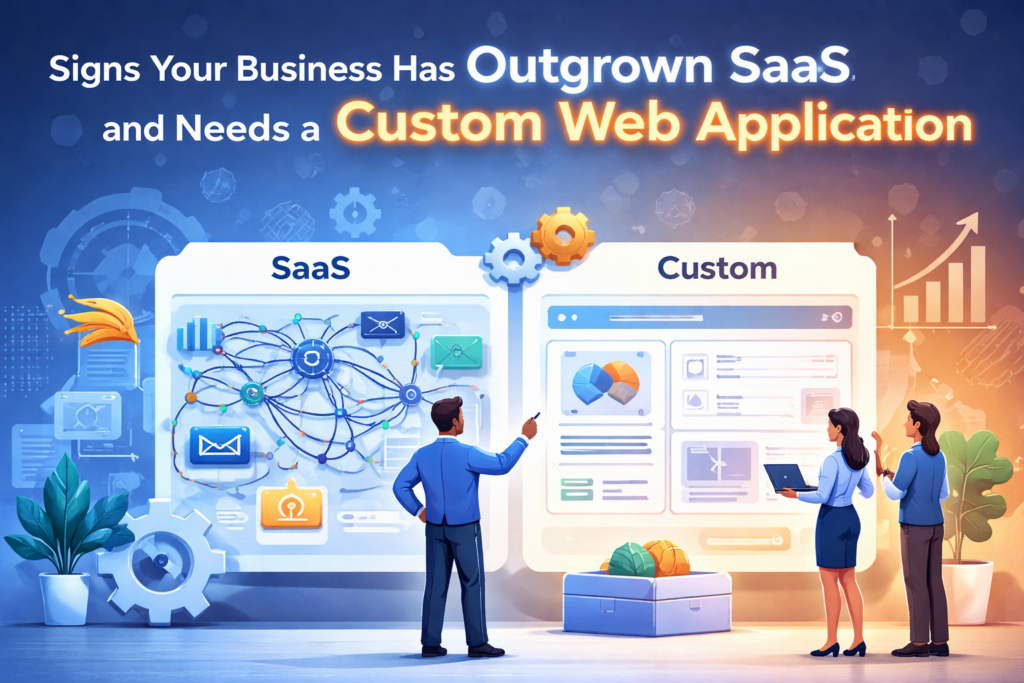
A complete executive guide to scalability, cost control, security, and long-term competitive advantage
Why SaaS Stops Working as Businesses Scale
Software-as-a-Service platforms solve early-stage problems fast. Speed of deployment, predictable subscriptions, and minimal setup make SaaS attractive during initial growth. Scale introduces complexity. Teams expand. Workflows mature. Data volume increases. Compliance pressure rises. At that stage, generic tools begin shaping operations instead of enabling strategy.
Organizations reach a point where efficiency declines despite rising software spend. That inflection point signals misalignment between business reality and SaaS architecture. A custom web application changes that equation by aligning technology with process, ownership, and long-term growth objectives.
Understanding the SaaS Growth Ceiling
What SaaS Is Designed to Solve — and What It Is Not
SaaS platforms target common business problems across wide markets. Product decisions optimize for the average customer. Unique workflows, proprietary logic, and industry-specific requirements receive limited support or remain permanently “on the roadmap.”
The One-Size-Fits-All Limitation
Feature bundling, rigid data models, and tiered pricing restrict flexibility. Customization often means configuration, not true adaptation. Over time, teams adapt behavior to software constraints, reducing operational excellence.
Why Growing Businesses Experience SaaS Friction
- Workflow fragmentation
- Data silos across platforms
- Rising per-user and usage-based fees
- Vendor-controlled product direction
- Limited compliance and security control
Sign 1: Teams Depend on Manual Workarounds to Complete Core Workflows
Spreadsheet dependency represents a system failure, not a productivity hack. Exports to Excel or Google Sheets introduce delays, errors, and accountability gaps.
Operational Risk Indicators
- Repetitive CSV imports and exports
- Manual approvals outside systems
- Data corrections after reporting
Metrics That Matter
- Weekly hours lost to manual intervention
- Error rate per workflow
- Rework percentage
A custom web application eliminates handoffs by automating workflows end-to-end.
Sign 2: Paying for Unused Features While Missing Critical Capabilities
SaaS pricing rewards breadth, not relevance. Organizations often use less than half of paid functionality while lacking industry-specific logic.
Feature Bloat vs Business Value
- Enterprise tiers purchased for single features
- Interfaces cluttered with irrelevant modules
- Workflow steps multiplied by generic design
Custom Advantage
Every feature exists for a defined business outcome. Interface design mirrors real operating behavior.
Sign 3: Integration Complexity Slows Operations Instead of Enabling Them
Modern SaaS stacks resemble interconnected dependencies held together by middleware such as Zapier, Make, or n8n.
Integration Fatigue Signals
- Broken workflows after vendor updates
- Conflicting data across systems
- Rising middleware subscription costs
SEO Semantic Cluster
- SaaS integration issues
- API dependency risk
- Workflow fragmentation
A unified custom application consolidates logic, data, and security within one architecture.
Sign 4: SaaS Pricing Scales Faster Than Revenue
Per-user pricing and usage-based fees compound quickly. What starts at $99 per month escalates into five-figure annual spend across CRM, analytics, project management, communication, and integration tools.
Long-Term Cost Reality
| Factor | SaaS Stack | Custom Web Application |
| Cost Growth | Vendor-driven | Predictable |
| User Scaling | Linear penalty | No per-seat cost |
| Ownership | None | Full IP ownership |
Custom development converts recurring expenses into a business asset.
Sign 5: Unique Processes Represent Competitive Advantage
Proprietary workflows define differentiation. Generic tools force compromise. Competitors using identical SaaS platforms gain functional parity.
Strategic Impact
- Loss of differentiation
- Process simplification to fit tools
- Reduced innovation velocity
Custom applications encode competitive logic directly into software, creating durable operational moats.
Sign 6: Data Security, Privacy, and Compliance Are Non-Negotiable
Multi-tenant SaaS architecture limits control over data residency, access policies, and audit depth.
Common Compliance Drivers
- HIPAA
- GDPR
- SOC 2
- PCI DSS
Custom security frameworks allow tailored encryption, granular permissions, and regulator-ready audit trails.
Sign 7: Vendor Roadmaps No Longer Align With Business Direction
SaaS vendors pivot markets, sunset features, and raise prices without operational context. Strategic dependency introduces risk.
Custom software restores roadmap ownership, release timing control, and prioritization authority.
Sign 8: Teams Cannot Access the Right Data at the Right Time
Poor UX, rigid role permissions, and fragmented dashboards delay decision-making.
Custom interfaces reflect real job functions, improving adoption, speed, and accountability.
Sign 9: SaaS Support Fails During Critical Moments
Ticket queues, AI chatbots, and generic responses delay resolution. Operational downtime translates directly into revenue loss.
Custom software partnerships provide contextual support from teams who understand system architecture and business workflows.
Sign 10: Business Needs Software That Evolves With Growth
SaaS update cycles introduce instability. Forced upgrades disrupt operations.
Custom platforms evolve intentionally, supporting stability, scalability, and long-term planning.
SaaS vs Custom Web Application: Strategic Comparison
| Dimension | SaaS | Custom Web Application |
| Control | Vendor-owned | Organization-owned |
| Scalability | Cost-penalized | Architecture-driven |
| Security | Shared responsibility | Full control |
| Differentiation | Limited | Embedded |
| ROI | Subscription expense | Appreciating asset |
The Business Case for Custom Web Application Development
ROI and Break-Even
- Typical break-even: 24–36 months
- Annual savings post break-even: $20,000+
- Efficiency gains across operations
Asset Creation
Custom applications hold resale value, support valuation, and strengthen competitive positioning.
Custom Web Application Development Lifecycle
- Discovery and workflow mapping
- Architecture and UX design
- Development and system integration
- Security and compliance validation
- Deployment and adoption
- Continuous optimization
When Custom Development Is Not the Right Choice
- Early-stage validation
- Short-term experimentation
- Rapidly shifting models
- Limited first-year budget
Choosing the Right Development Partner
Execution quality defines success. Architecture decisions compound over years.
Why Choose Inspire Tech
Inspire Tech delivers enterprise-grade custom platforms designed around real business workflows, compliance requirements, and growth trajectories. Strategy-led discovery, scalable architecture, and post-launch evolution separate Inspire Tech from commodity development vendors.
Organizations seeking reliable web application development services gain long-term partners, not transactional builds.
Future-Proofing the Business With Custom Technology
Custom platforms eliminate tool sprawl, enable intelligent automation, and align technology investment with strategic objectives.
Conclusion: SaaS Is a Tool — Custom Software Is Infrastructure
SaaS serves common needs efficiently. Growth introduces complexity that generic tools cannot absorb. Signs appear through workarounds, rising costs, integration failures, and strategic misalignment.
A custom web application transforms technology from constraint into advantage. Businesses reaching this inflection point face one decision: continue adapting operations to tools or build infrastructure that adapts to the business.
Frequently Asked Questions
How much does custom web application development cost
Typical ranges fall between $50,000 and $250,000 depending on scope and complexity.
How long does development take
Most projects complete within four to nine months. MVPs launch sooner.
Can custom applications integrate with existing SaaS tools
Yes. APIs and webhooks support gradual migration.
Is custom software secure
Security improves with full control over architecture and policies.
How to know readiness for custom development
Annual SaaS spend exceeding $30,000, repeated workarounds, compliance pressure, and proprietary workflows signal readiness.