
Website speed and performance now define whether a digital business grows or stalls. Users expect instant access, search engines reward fast experiences, and even a small delay can reduce conversions, engagement, and trust. In this environment, performance is no longer a technical afterthought. It is a strategic outcome shaped by how a website is designed, developed, hosted, and maintained.
A professional web development service does far more than write code. It engineers how quickly content loads, how efficiently systems respond, and how reliably users interact with the site across devices and locations. This guide explains, in detail, how web development services improve website speed and performance, which metrics matter most, and why businesses that treat performance as a core capability consistently outperform competitors.
Website Speed and Performance Explained Clearly
Website Speed vs Website Performance
Website Speed
- Measures how fast website content loads
- Focuses on page load time and visual rendering
- Impacts first impression and bounce rate
Website Performance
- Includes speed plus responsiveness and stability
- Covers how the site behaves during interaction
- Reflects overall efficiency across devices and networks
Key Insight
- A fast-loading page that becomes unresponsive or shifts layout still delivers poor performance
Key Website Performance Metrics
Professional web development services optimize measurable attributes that search engines and users both value.
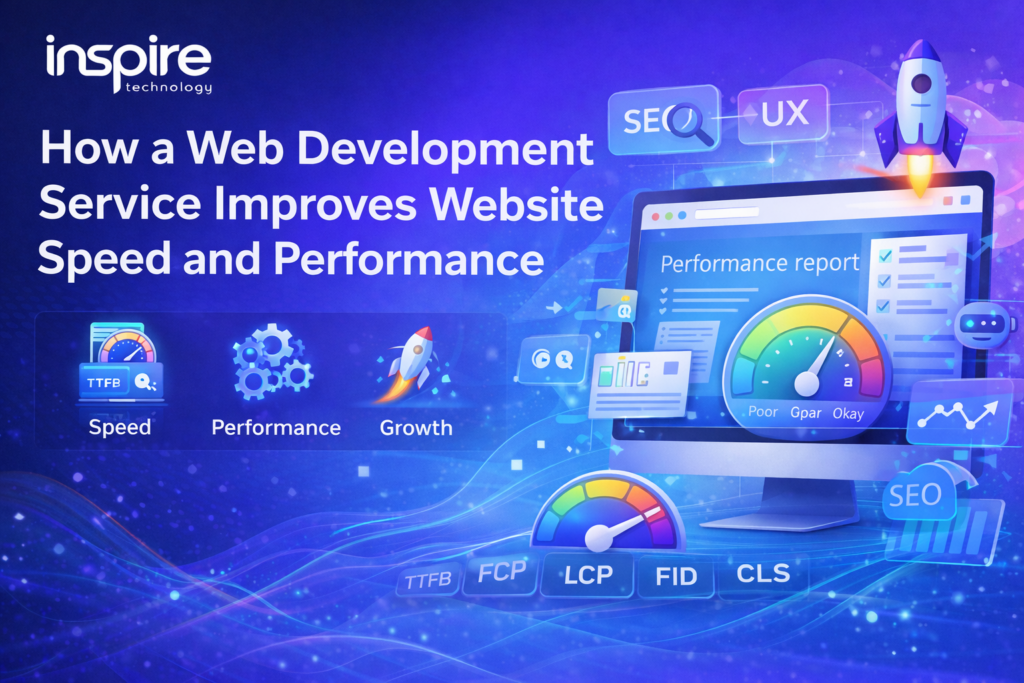
- Time to First Byte (TTFB)
Measures how quickly the server starts responding to a browser request - First Contentful Paint (FCP)
Tracks when the first visible content appears on screen - Largest Contentful Paint (LCP)
Measures when the main page content becomes visible - Time to Interactive (TTI)
Indicates when users can fully interact with the page - First Input Delay (FID)
Measures responsiveness to user interaction - Cumulative Layout Shift (CLS)
Evaluates visual stability and unexpected layout movement
Together, these metrics form Google’s Core Web Vitals, which directly influence search rankings and user satisfaction.
Website Speed vs Website Performance: Comparison Table
| Aspect | Website Speed | Website Performance |
| Primary focus | Load time | Load, interaction, and stability |
| Key concern | How fast content appears | How smoothly the site behaves |
| User impact | First impression | Overall experience |
| SEO relevance | Ranking factor | Core Web Vitals evaluation |
| Measurement | Page load metrics | Multiple UX performance metrics |
Why Website Speed Is a Business Imperative
Website speed impacts every commercial outcome connected to digital presence.
User Experience and Engagement
Research consistently shows that users abandon slow websites. A page that loads in over three seconds loses a significant portion of visitors before content is even seen. Faster websites reduce bounce rates, increase time on site, and create trust through responsiveness.
Speed shapes perception. A slow website signals inefficiency. A fast website signals reliability.
Search Engine Rankings and Visibility
Google uses page speed and Core Web Vitals as ranking signals across desktop and mobile search. Faster websites are easier to crawl, index more efficiently, and perform better in competitive search results.
Speed optimization is no longer optional SEO hygiene. It is a ranking requirement.
Conversion Rates and Revenue
For ecommerce and service businesses, every second matters. Studies show a one second delay can reduce conversions by up to seven percent. Performance improvements translate directly into revenue growth without increasing traffic.
Common Causes of Poor Website Performance
Before optimization begins, developers identify why websites slow down.
Frontend Performance Issues
- Unoptimized images increase page size dramatically.
- Render blocking CSS and JavaScript delay content visibility.
- Excessive HTTP requests overload the browser.
- Heavy fonts and animations increase rendering time.
Backend and Infrastructure Problems
- Slow server response times increase Time to First Byte.
- Unindexed database queries cause processing delays.
- Lack of caching forces repeated computation.
- Low quality hosting increases latency under traffic.
Design Decisions That Hurt Speed
- Overdesigned layouts introduce unnecessary assets.
- Video backgrounds and sliders increase payload size.
- Third party scripts and plugins block rendering.
Professional web development services resolve these issues systematically, not reactively.
What a Web Development Service Actually Does Differently
A true web development service designs performance into the system rather than fixing it later.
Performance First Architecture Planning
Developers plan speed from the earliest stage. Wireframes account for asset budgets. Mobile rendering is prioritized. Content hierarchy supports faster initial paint.
At Inspire Tech, performance planning starts before design execution, ensuring that visual creativity never compromises load speed or stability.
Clean and Efficient Code Engineering
Developers write optimized HTML, CSS, and JavaScript that browsers can parse quickly. Code is modular, reusable, and free from redundancy. Assets load only when required using lazy loading and deferred execution.
This foundation alone can reduce load time significantly.
Frontend Optimization Techniques Used by Professionals
Frontend optimization determines how fast users perceive a website.
Image Optimization at Scale
Images often account for most page weight. Web development services compress images, convert them to modern formats like WebP and AVIF, and serve responsive sizes using srcset. Lazy loading ensures offscreen images do not block initial load.
Reducing HTTP Requests
Developers combine CSS and JavaScript files, use SVG sprites for icons, and reduce font variations. Fewer requests result in faster rendering and smoother performance.
Critical Rendering Path Optimization
Critical CSS is inlined so above the fold content renders immediately. Non essential scripts load asynchronously. This approach dramatically improves perceived speed and Core Web Vitals.
Backend and Server Side Performance Optimization
Speed does not stop at the browser.
Server Response Time Optimization
Developers tune server configurations, reduce middleware layers, and select backend frameworks suited to traffic patterns. Faster server responses lower Time to First Byte and improve overall responsiveness.
Database Performance Engineering
Indexed queries, optimized joins, and query caching reduce processing time. Developers also normalize or denormalize data based on usage patterns to improve speed.
Caching Strategies That Matter
Page caching serves static HTML instantly.
Object caching stores frequent database results in memory.
Browser caching reduces repeat downloads.
Opcode caching speeds up server side execution.
Combined, these techniques dramatically reduce load time and server strain.
The Role of CDNs and Modern Hosting
Content Delivery Networks play a critical role in global performance.
CDNs store cached content across distributed servers, serving users from the nearest location. This reduces latency and improves reliability during traffic spikes.
Professional web development services configure CDNs like Cloudflare or Amazon CloudFront properly, ensuring cache rules align with content behavior.
Modern cloud hosting on AWS, Azure, or Google Cloud enables scalability, redundancy, and faster response times compared to traditional shared hosting.
Technology Stack Choices That Influence Performance
Framework and stack selection affects speed more than most businesses realize.
Frontend Framework Impact
React and Vue enable modular rendering. Next.js and Nuxt.js support server side rendering and static generation, improving initial load speed. Astro and Svelte prioritize minimal JavaScript delivery.
Backend Stack Considerations
Node.js excels in high concurrency environments. PHP and Python frameworks offer stability and scalability when optimized correctly. Serverless architectures reduce idle overhead and scale automatically.
Inspire Tech selects stacks based on performance goals, not trends, ensuring the right balance between speed, maintainability, and growth.
Core Web Vitals Optimization in Practice
Professional developers optimize Core Web Vitals deliberately.
Largest Contentful Paint improves through image optimization, CDN delivery, and server response tuning.
First Input Delay improves by reducing JavaScript execution and prioritizing interactivity.
Cumulative Layout Shift improves by defining media dimensions and stabilizing layout rendering.
These actions directly impact SEO and user experience.
Performance Testing and Continuous Monitoring
Optimization without measurement is guesswork.
Tools Used by Web Development Services
Google PageSpeed Insights evaluates performance and SEO.
Lighthouse audits speed, accessibility, and best practices.
GTmetrix analyzes load time and asset behavior.
WebPageTest provides waterfall diagnostics.
Pingdom monitors uptime and response speed.
Real User Monitoring vs Lab Testing
Lab tools simulate performance. Real user monitoring collects data from actual visitors. Professional web development services use both to ensure accuracy and consistency over time.
Speed Optimization by Website Type
Different websites require different performance strategies.
Ecommerce Websites
Product image optimization, checkout flow speed, and platform specific tuning for Shopify, WooCommerce, or Magento directly impact conversions.
Content Heavy Blogs and Media Sites
Article caching, lazy loading media, and controlling third party scripts ensure fast content delivery even during traffic spikes.
SaaS Platforms and Web Applications
API optimization, route based lazy loading, and bundle analysis improve interaction speed and scalability.
Corporate and Portfolio Websites
Static site generation, optimized media, and minimal scripting balance design quality with performance.
Web Design vs Web Development in Performance Control
Web design influences asset weight and layout complexity. Web development controls how assets load, execute, and scale.
Design contributes partially to speed. Development controls it end to end.
This distinction is why businesses that rely solely on design optimization rarely achieve sustained performance gains.
Future Trends in Website Performance Optimization
- Edge Computing
Processing moves closer to users through CDN edge networks, reducing latency, improving Time to First Byte, and maintaining fast performance during traffic spikes. - AI-Driven Optimization
AI predicts user behavior to preload content, automate caching, and detect performance issues before Core Web Vitals are affected. - WebAssembly (Wasm)
Enables near-native performance for complex browser tasks such as media processing, data visualization, and real-time applications. - Sustainable Web Development
Faster, lighter websites reduce data transfer, server load, and energy consumption while improving user experience and SEO. - Continuous Performance Engineering
Performance monitoring, automated audits, and CI/CD integration ensure speed standards evolve with devices, networks, and user expectations.
Final Takeaway
Website speed and performance are not fixed after launch. They are built into architecture, code, infrastructure, and workflows. A professional web development service transforms performance from a risk into a competitive advantage.
Inspire Tech approaches development with performance as a core principle, not a checklist item. By aligning design, engineering, and infrastructure, Inspire Tech delivers websites that load faster, rank higher, convert better, and scale confidently.
Speed is not something you patch. It is something you engineer.