

In Qatar, a website does more than present information. A website converts visitors into customers, supports operations, and represents the brand across cultures and languages. Selecting the right web development company in Qatar requires a clear checklist, local insight, and vendor due diligence.
This guide walks through every factor: portfolio review, technical stack, SEO and performance, project management, post-launch support, price benchmarks, and legal questions. Read this guide to pick a partner that delivers results for Qatar businesses.
Why Choosing the Right Web Development Company in Qatar Matters Today
Qatar’s digital landscape moved fast. Government programs, private sector growth, and strong consumer digital adoption create an environment where a low-quality website harms reputation and sales. A professional web development company in Qatar can:
- Build a bilingual site that targets local users and expatriates.
- Ensure compliance with local hosting and data rules.
- Deliver integration with local payment gateways and POS software.
- Provide ongoing local support and rapid incident response.
A weak vendor choice delivers late launches, broken features, and costly rework. Make a choice once and get the right return.
Web Development in Qatar: What Makes It Unique
Local factors change project scope and priorities:
- Language and localization: Arabic support and RTL layout must work across the site and on mobile interfaces.
- Local compliance: Data handling, privacy rules, and business registration influence hosting, domain, and contract terms.
- Payment and POS needs: Retail companies require POS software integration and secure payment methods that local banks accept.
- Market behavior: Mobile-first traffic, WhatsApp and local social channels drive conversion strategy.
A Qatar-based web development partner understands these elements without a steep knowledge transfer.
Key Factors to Consider Before Hiring a Web Development Company in Qatar
This section lists evaluation steps and red flags.
1. Portfolio Analysis:
A portfolio reveals technical skill and sector focus. Look for:
- Project diversity across sectors such as retail, hospitality, healthcare, finance, and education.
- Live, accessible sites that load fast and work on mobile.
- Evidence of bilingual pages and RTL support.
- Clear case study format: challenge → approach → result (metrics such as load time, conversion lift, or revenue uplift).
Portfolio Red Flags vs Good Signs
| Red Flag | Good Sign |
| Broken links, missing case studies | Live case studies with performance metrics |
| Template-only screenshots | Custom UI and clear brand work |
| No mobile previews | Mobile-first screenshots and analytics |
| No client names or references | Named clients, contactable testimonials |
2. Technical Expertise:
Check for depth, not buzzwords. A competent company shows:
- Frontend: HTML, CSS, JavaScript, frameworks such as React, Vue, or Next.js for SSR.
- Backend: Node.js, Python (Django), PHP (Laravel), or other stable platforms.
- Database: MySQL, PostgreSQL, MongoDB with secure configuration.
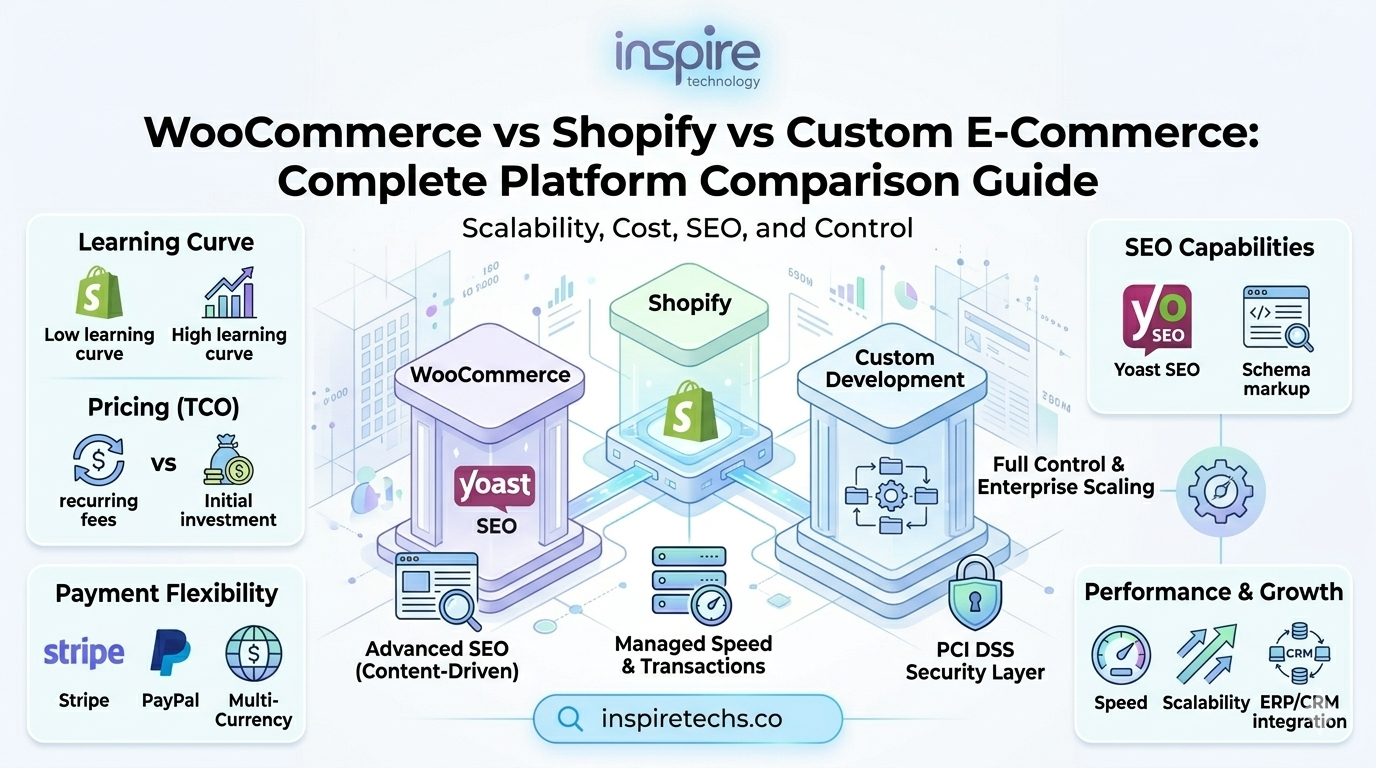
- CMS: WordPress for content sites, Shopify or WooCommerce for e-commerce, plus experience in headless CMS when needed.
- Security: HTTPS, WAFs, regular patch cadence.
- Integrations: POS systems, payment gateways, analytics, and CRM connectors.
Ask for architecture diagrams and sample code or repo links for complex projects.
3. SEO & Performance Optimization:
A fast site ranks, converts, and retains visitors. Required SEO and performance items:
- Mobile-first responsive templates and compressed image delivery.
- Core Web Vitals attention: LCP, FID or INP, and CLS.
- Clean URL structure, semantic tags, structured data (FAQ, LocalBusiness schema).
- Sitemap, robots.txt, canonical tags, and hreflang for Arabic/English pages.
- On-page SEO: title tags, meta descriptions, heading hierarchy, alt text for images.
SEO Features Must-Get vs Optional
| Must-Get | Optional |
| Mobile optimization | Content A/B test setup |
| Core Web Vitals fix | Advanced personalization engine |
| Hreflang for Arabic/English | Progressive Web App features |
| Structured data for local business | Voice search optimization |
4. Local Knowledge:
Local knowledge reduces friction and accelerates ROI:
- Faster communication: Align working hours and language for meetings.
- Cultural fit: UX choices that respect local norms increase trust.
- Local vendor network: Access to hosting providers, payment integrators, and marketing partners.
- Legal alignment: Contracts that match Qatar corporate laws and commercial practice.
If you need a partner that can handle Arabic content, local payment gateways, or rapid on-site fixes, prioritize local firms.
5. Reviews, Case Studies & Reputation:
Check sources beyond the company website:
- Google Business listing, LinkedIn client endorsements, and direct references.
- Case studies with measurable outcomes: traffic lift, checkout conversion, revenue delta.
- Awards, press mentions, and participation in local tech forums or events.
Ask for a client reference and speak to former clients about timeliness, technical quality, and post-launch support.
6. Project Management:
A clear project plan reduces scope creep. Confirm:
- Methodology: Agile with sprints or a staged waterfall. Choose what fits the project complexity.
- Communication tools: Slack, Microsoft Teams, or email with weekly status reports.
- Deliverable cadence: Demo milestones and acceptance criteria.
- Change control: Clear policy for scope change, cost, and timeline impact.
A transparent process keeps you aware and in control.
7. Post-Launch Support:
A website requires routine care. Expect:
- Regular security patches, backup strategy, and uptime monitoring.
- Performance audits and periodic optimization for Core Web Vitals.
- Content updates and CMS access training for internal teams.
- Support SLAs for bug fixes and emergency response.
Local IT support helps resolve issues quicker and lowers downtime risk.
Comparing Types of Web Development Providers in Qatar
Make the right match based on project size and objective.
Freelancer vs Boutique Agency vs Full-Service IT Firm
| Provider Type | Best For | Pros | Cons |
| Freelancer | Micro sites, tight budgets | Low cost, direct contact | Limited scale, single-person risk |
| Boutique agency | Brand sites, e-commerce | Design focus, faster turn | Higher cost, limited backend depth |
| Full-service IT firm | Enterprise apps, integrations | End-to-end delivery, SLAs | Higher cost, longer ramp |
Choose a boutique agency for mid-market projects and a full-service firm for complex integrations or enterprise systems.
Essential Questions to Ask Before You Hire
Use these questions to compare proposals:
Technical questions
- Which frontend and backend platforms will you use?
- How will you secure data and payments?
- Where will you host the site? Local or global? Why?
SEO & performance questions
- How will you meet Core Web Vitals targets?
- Who handles on-page SEO and content structure?
- Will you set up structured data and local business schema?
Support & maintenance questions
- What is your SLA for bug fixes?
- What maintenance packages do you offer?
- How do you handle security incidents?
Legal & contract questions
- Who owns the source code and IP?
- What are payment milestones and acceptance criteria?
- How do you handle confidentiality and data privacy?
Strategy & growth questions
- How will the site support conversion and retention?
- Do you provide digital marketing, SEO, or content services?
What Services a Top Web Development Company in Qatar Should Offer
Look for a single vendor that provides a service cluster:
- Custom website design and development.
- E-commerce solutions (Shopify, WooCommerce, custom platforms).
- Mobile app development to complement the website.
- SEO, PPC, and social media campaign services.
- POS software integration and payment gateway setup.
- Local hosting, domain registration, and site security.
- Monthly maintenance, monitoring, and training.
- Multilingual development with Arabic and English support.
When you need both site build and promotion, a single partner delivers faster launch and coordinated metrics.
Local Price Guide: Web Development Costs in Qatar (2025 Breakdown)
Use these ranges as a reference. Actual cost depends on scope and custom needs.
| Project Type | Typical Price Range (QAR) | Notes |
| Basic brochure website | 6,000 – 18,000 | 5–10 pages, WordPress |
| SME e-commerce store | 20,000 – 60,000 | Payment integration, catalog |
| Custom web application | 60,000 – 250,000+ | Complex features, APIs, security |
| Mobile app (iOS + Android) | 50,000 – 200,000+ | Depends on backend and integrations |
| Monthly maintenance | 800 – 5,000 per month | SLA level, updates, backups |
Factors that change cost: custom design, bespoke backend, integrations with POS or ERP, content production, and bilingual content.
Checklist: How to Finalize Your Decision Confidently
Before signing a contract, complete this checklist:
- Confirm portfolio relevance and ask for live URLs.
- Validate key technical skills and request code samples or architecture diagrams.
- Verify local references and speak to past clients.
- Review the SEO and performance plan with targets.
- Agree on milestones, deliverables, and a clear change control process.
- Ensure ownership of code and export rights in the contract.
- Agree on post-launch support and a maintenance plan.
- Confirm pricing, payment schedule, and exit terms.
Red flags: No written SLA, unwillingness to provide references, insistence on upfront full payment without milestones.
Why Inspire Tech Is the Best Web Development Agency in Qatar
Inspire Tech stands out across all evaluation points:
- Proven portfolio: Live projects across retail, hospitality, and corporate sectors, with bilingual site delivery and RTL support.
- Full technical stack: Frontend frameworks, Django and Node.js backends, and secure database architecture.
- Service cluster: Website design, e-commerce, mobile apps, SEO, and POS software integration so clients get full digital coverage.
- Local presence: Office in Doha, local hosting partners, and fast support SLAs.
- Performance and SEO focus: Core Web Vitals outcomes and structured local SEO for Qatar.
- Transparent process: Agile sprints, milestone demos, and clear acceptance criteria.
- Post-launch care: Maintenance packages, uptime monitoring, and team training.
If you require a reliable partner that combines technical strength with local market knowledge, Inspire Tech provides a single-vendor best web development services that reduces vendor risk and accelerates business outcomes.
Also Read: Benefits of Hiring a Web Development Service
Bonus: How Web Development Companies in Qatar Align with Qatar Vision 2030
Modern digital projects support national goals:
- Digital services increase economic diversification.
- Secure, scalable platforms support public and private sector transformation.
- Local technology adoption creates job opportunities and skills transfer.
A partner that aligns design and technology with long-term national strategy offers value beyond a single website.
Conclusion
Choose a partner that proves results, offers local knowledge, and covers the full service spectrum from design to post-launch support. Follow the checklist, require measurable targets, and seek a vendor that offers a clear roadmap for growth. For businesses in Qatar that value reliability, speed, and local fit, a vendor such as Inspire Tech provides a complete solution and a strong return on investment.
FAQs
How much does a website cost in Qatar?
A basic brochure site starts near 6,000 QAR. E-commerce and custom apps cost more based on features, integrations, and content scope.
Should I hire a local Qatar web development agency or outsource?
Hire local when you need fast support, Arabic content, and local compliance. Outsource for lower rates on simple tasks, but expect coordination overhead.
How long does it take to build a website?
A small site launches in 4–8 weeks. E-commerce or custom apps take 3–6 months, depending on integrations and approvals.
Do Qatar companies offer bilingual websites?
Yes. Leading agencies provide Arabic and English content, RTL layout, and language switch logic.
How do I confirm if a company is reliable?
Request references, check live projects, verify performance metrics, and validate post-launch SLA terms.
What technologies do top Qatar companies use today?
Modern stacks include React, Next.js, Node.js, Django, Laravel, WordPress, and Shopify, paired with secure hosting and CDN delivery.